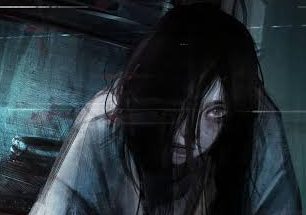
The stories behind female japanese urban legends often begin in familiar places: a quiet street, a school corridor, a train platform, or a house that looks completely ordinary from the outside. What makes them unsettling is how easily these everyday settings become part of something much darker.These stories aren’t just random campfire fluff. They mix everyday modern settings with centuries-old fears about women who suffered, died, and came back wrong. From mysterious women on quiet streets to half-bodied spirits racing after you on their hands, the lineup is genuinely unsettling. And yes, we’ll get into the classic ones too, because the line between ancient ghosts and today’s urban rumors is thinner than you’d think.
The Legend of Kuchisake-onna
You can’t talk about this stuff without starting with the big one. Kuchisake-onna, the Slit-Mouthed Woman, is basically the poster girl for modern Japanese horror folklore. The story exploded in 1978–1979, starting in Gifu Prefecture and spreading like wildfire among schoolchildren. A tall, beautiful woman wearing a surgical mask stops you on a quiet street or path and asks the simple, polite question: “Am I pretty?”
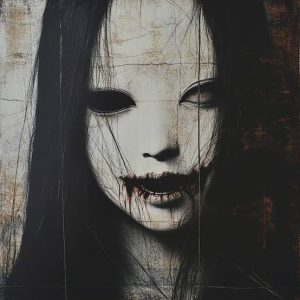
Say yes, and she slowly pulls the mask down to reveal a mouth cut from ear to ear in a grotesque grin. Then she asks again: “Even like this?” Answer wrong (and almost every answer is wrong), and those scissors or that knife come out. Some versions say she’ll make your mouth match hers. Others just end with you dead in the alley.
What makes her so effective is how ordinary the setup feels. Surgical masks were already common in Japan for colds and pollution. A woman asking about her appearance taps into beauty standards and social politeness. The legend caused actual panics: parents walked kids home in groups, schools issued warnings, and police even investigated reports. One theory links her to older stories of mutilated women or jealous wives from the Edo period, but the 1979 version is pure urban legend energy. She belongs squarely in the category of female japanese urban legends that feel like they could happen tomorrow night on your own street.
Survival tips float around, of course. Answer “average” or “so-so” to confuse her. Offer hard candy (bekko ame). Or shout “pomade” three times. Whether any of that works is anyone’s guess, but the fact that people still debate the rules shows how alive the story remains.
The Sound That Means You’re Too Late: Teke Teke
If Kuchisake-onna is the polite questioner, Teke Teke is pure relentless pursuit. Picture a young woman or schoolgirl whose body was severed at the waist by a train. Now she drags her upper half along the ground on her hands or elbows, moving at terrifying speed. The name comes from the scraping sound she makes: teke-teke, teke-teke.
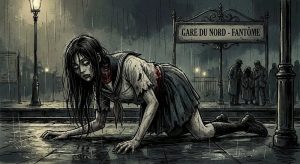
Most versions place her near train stations or dark urban roads at night. She chases you, catches you, and slices you in half the same way she died. Some tellings name her Kashima Reiko and add a whole riddle sequence you have to answer correctly if she corners you. Others just say run, and pray you’re faster than something that can allegedly keep up with cars.
This one feels especially Japanese because of the train element. Japan’s dense rail network and the very real danger of railway accidents give the legend a grounded horror. It’s also a classic onryō tale: a spirit so full of rage at an unfair, violent death that she can’t rest until she shares the suffering. You’ll hear variations where victims become Teke Teke themselves, spreading the curse.
The Second Mouth: Futakuchi-onna
Futakuchi-onna is the woman with two mouths. By day she looks ordinary—quiet, almost timid, with long black hair carefully arranged. At night the hair parts and a second mouth opens on the back of her skull. It whispers, it demands food, and if it is not fed it tears at her own scalp with invisible teeth until she wakes up bleeding.
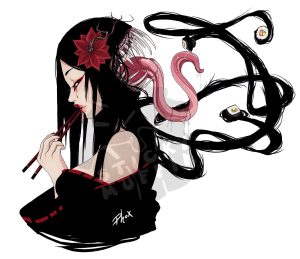
The story comes from Edo-period kaidan collections and later woodblock prints. One common origin claims a stepmother who starved her husband’s child; the gods punished her by giving her a second mouth that would never stop hungering. Another version simply says any woman who is forced to hide her true appetite or resentment long enough may grow the extra mouth. Either way, the horror is domestic and intimate: the monster lives under the same roof, shares the same bed, and only reveals itself when the lights are out.
She is neither pure onryō nor full demon. She is a yōkai born from suppressed anger and social pressure, a reminder that the most frightening Japanese female spirits often start as ordinary women who were never allowed to speak—or eat—their fill.
Giants, Shadows, and the Ones Who Wait
Not every female figure in these stories is a young woman. Hachishakusama, or Hasshaku-sama, is an eight-foot-tall woman with long black hair who stalks children. She announces herself with a soft “po-po-po” sound. Once she’s noticed a kid, she follows for days or weeks before taking them. The “sama” honorific is telling; it’s the respectful title you use for gods and things you really, really don’t want to offend.
Then there are the older, more folkloric figures that blur into urban rumor. Ubume appears as a woman carrying a baby, often bloodstained from the waist down. She asks you to hold the child for a moment. The baby grows heavier and heavier until you realize it’s a stone or a bundle of leaves, and the mother has vanished. These are spirits of women who died in childbirth, driven by maternal love rather than pure revenge. Still terrifying, just in a different key.
From Onryō to Oni: The Deeper Roots
Modern urban legends didn’t appear out of nowhere. They sit on top of a much older layer of Japanese female ghosts. The classic ghost image—white burial kimono, long tangled black hair covering the face, no visible feet—comes largely from Edo-period theater and woodblock prints. The most famous are the “three great vengeful ghosts”: Oiwa from the Yotsuya Kaidan (poisoned and disfigured by her husband, she returns with a ruined face and falling hair), Okiku of the well at Himeji Castle (thrown down the well after breaking a precious plate, she counts to nine forever), and Otsuyu of the Peony Lantern.
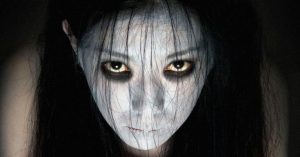
These spirits are usually onryō—vengeful ghosts fueled by betrayal, injustice, or violent death. The cultural idea is that a person who dies with intense unresolved emotion can refuse to move on. Women, historically more vulnerable to certain kinds of domestic and social violence, became the most common carriers of that rage in the stories.
When the rage or jealousy grows strong enough, the spirit can tip over into something more demonic. That’s where we meet the kijo, or demon women. These are former humans twisted by karma, resentment, or pure fury into oni-like forms. The most famous theatrical version is the Hannya mask: horned, fanged, and wild-eyed, representing a woman consumed by jealousy. Other names that surface when people talk about Japanese female oni names include Yamauba (the mountain crone who lives in the deep woods and eats travelers) and various regional onibaba figures. The phrase Japanese demon names female often pulls up these same figures plus shapeshifters like the jorōgumo (spider woman) or the yuki-onna (snow woman), though the latter sits more on the spirit side than the pure demon side.
The Hannya is especially interesting because it started as a Noh theater mask and became a cultural shorthand for female rage turned monstrous. You see her face on tattoos, in horror films, and even in modern fashion. She’s the bridge between the tragic vengeful ghost and the full-blown kijo.
Why These Stories Stick
What keeps all of this alive in 2026? A few things. First, the settings are ordinary: school toilets, train platforms, quiet residential streets, mountain paths. The horror isn’t locked in a haunted castle; it’s next to the vending machine. Second, the stories usually come with rules or tests. Answer the question correctly, knock the right number of times, run in the right direction. That turns passive fear into an active game kids can play (and scare each other with).
Third, they reflect real anxieties. Beauty standards and social pressure show up in Kuchisake-onna. The danger of public transport appears in Teke Teke. Maternal loss and the fear of dying in childbirth live on in Ubume. Historical power imbalances between men and women echo through Oiwa and Okiku. Even when the details change, the emotional core stays sharp.
And of course the internet and media keep recycling them. Films, manga, games, and short-form video constantly remix the classics. A new generation discovers Hanako-san or Teke Teke every few years, adds a twist, and the cycle continues.
Living With the Legends
That’s the point. They are cultural tools for processing fear, injustice, and the things we can’t control. They also remind us that the most effective monsters are the ones who look almost human until the moment they don’t.
Whether you treat them as pure entertainment, psychological metaphors, or actual warnings whispered from the past, the female figures of Japanese folklore and urban legend form one of the richest, most enduring horror traditions in the world. Next time you hear a soft scraping sound on the pavement behind you, or notice a masked woman asking an oddly personal question, maybe just keep walking. Politely. Quickly. And whatever you do, think carefully before you answer.