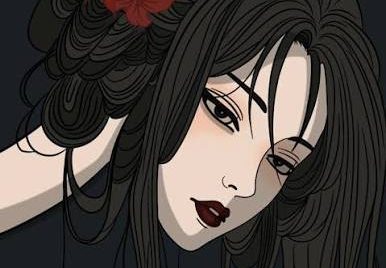
The first thing that makes a rokurokubi unsettling is how ordinary it can look. During the day, it might be a woman living in a quiet village, visiting neighbors, doing household chores, or walking through the street without attracting any attention. Nothing about her appearance necessarily suggests that something is wrong.
Then night comes, and her neck begins to stretch.
In Japanese folklore, the rokurokubi is a strange creature that looks human but possesses an impossible ability: its neck can extend far beyond its natural length. Some stories describe the head rising toward the ceiling, peering through windows, or moving around a room while the body remains asleep. Other versions are less dramatic, making the creature seem almost like an ordinary person who happens to hide an extraordinary secret.
What I find interesting about this legend is that the rokurokubi does not always behave like a monster from a typical horror story. It can be frightening without attacking anyone. Sometimes, the horror comes from the simple possibility that the person sleeping nearby is not quite what they appear to be.
What Is a Rokurokubi?
A rokurokubi is a figure from Japanese folklore, usually depicted as a human whose neck can stretch to an unnatural length. The name is commonly associated with the idea of a long neck.
The creature is often confused with another Japanese supernatural figure called the nukekubi. The two are related in appearance, but traditional descriptions distinguish them by how their heads move.
A rokurokubi stretches its neck while remaining physically connected to its body. A nukekubi, by contrast, is generally described as a creature whose head separates completely and flies away, sometimes leaving its body behind.
Modern retellings do not always maintain this distinction, so the two figures occasionally get mixed together in books, illustrations, and online discussions.
The rokurokubi is not necessarily a giant, a spirit with a monstrous face, or a creature covered in strange features. In many depictions, it looks like an ordinary Japanese woman. That contrast is part of what makes the legend memorable.
How the Legend Appears in Japanese Folklore
Japanese supernatural traditions contain many beings that look human but possess unusual abilities. Some are openly frightening, while others remain hidden among ordinary people. The rokurokubi belongs to this second group.
Stories about the creature became familiar through the broader tradition of kaidan, a Japanese term associated with strange tales and ghost stories. These stories were shared in different forms, including oral storytelling, illustrated books, theatrical entertainment, and later popular media.
There is no single version of the rokurokubi story that explains every detail. Folklore changes as people retell it, and different storytellers emphasize different aspects of the creature.
In one version, a person may have no idea that their neck stretches during sleep. In another, the condition may be connected to supernatural forces or moral failings. Some stories present the rokurokubi as a frightening presence, while others treat the discovery of its secret as an awkward or even comic incident.
It is worth remembering that these stories belong to folklore rather than documented natural history. They tell us about traditional fears, storytelling, and ideas about the hidden side of human nature. They are not evidence that people can physically transform in this way.
What Happens at Night?
The nighttime transformation is the feature most often associated with the rokurokubi.
Imagine staying in a traditional room after the lamps have been extinguished. The house is quiet, and the person sleeping nearby appears perfectly normal. Then a head rises slowly into the darkness, its neck stretching farther than any human neck should.
In some retellings, the head moves around the room or looks through gaps in the walls. In others, it approaches sleeping people or investigates objects that would normally be out of reach.
The details differ from story to story. There is no universal rule governing how far the neck can stretch, how the transformation begins, or what the creature intends to do.
That flexibility is typical of folklore. A storyteller can make the same basic idea frightening in several ways without needing to invent an entirely different monster.
The most effective part of the scene is often the contrast between the quiet room and the impossible movement. The body appears vulnerable and asleep, while the head behaves as if it belongs to something that does not follow ordinary physical rules.
Are Rokurokubi Evil?
Not every story gives the rokurokubi the same personality.
Some versions portray the creature as dangerous, especially when it approaches sleeping people or appears in the darkness without warning. Others focus on the secret itself rather than on an attack.
This makes the rokurokubi different from monsters whose main purpose is to chase or kill their victims. Its presence can be disturbing even when nothing violent happens.
The creature also raises a question that appears in many supernatural stories: can an ordinary person hide something extraordinary without anyone noticing?
A neighbor, a relative, or a person sharing a room might appear completely familiar during the day. The frightening possibility is that their normal appearance tells you very little about what happens when nobody is watching.
That idea is more interesting than simply labeling every rokurokubi as evil. Folklore rarely remains consistent enough for such a broad rule to cover every version.
Rokurokubi and Nukekubi: What Is the Difference?
The distinction between these two figures is useful if you are exploring Japanese folklore.
A rokurokubi is primarily associated with a neck that stretches. Its head remains connected to its body, even when it moves to an impossible distance.
A nukekubi is commonly described as having a head that detaches from the body and travels independently. Some stories give the flying head a more openly predatory role.
The visual difference is straightforward, but modern popular culture sometimes blurs the categories. Illustrations may use the names interchangeably, and newer stories can borrow elements from both.
If you encounter a tale in which the head stretches upward while remaining attached, rokurokubi is generally the more appropriate term. If the head separates completely, nukekubi is usually the closer match.
These are broad distinctions rather than a guarantee that every historical account follows the same rules.
How the Rokurokubi Became a Familiar Image
The rokurokubi has remained recognizable because its central image is easy to understand. A person looks normal until one part of their body begins behaving in a way that should be impossible.
That image works particularly well in illustrations. An artist does not need to show a complicated transformation or a violent scene. A long neck disappearing into the shadows of a room can communicate the entire idea.
The figure has also appeared in modern Japanese entertainment, including manga, animation, games, and horror-themed collections of supernatural creatures. Each adaptation can emphasize a different side of the legend. One may make the rokurokubi frightening, another may turn it into a comic character, and another may use it as a visual symbol of the uncanny.
These modern appearances should not automatically be treated as evidence about older folklore. A contemporary adaptation can change a creature’s personality, powers, or origin to fit its own story.
Still, modern media has helped keep the image recognizable to audiences who may never have encountered traditional Japanese ghost stories.
Why the Rokurokubi Still Feels Unsettling
The rokurokubi is frightening because it does not need to look monstrous all the time.
Many horror creatures announce themselves immediately. Their faces, bodies, or behavior make it obvious that something is wrong. The rokurokubi can hide in plain sight, and that makes the eventual discovery more disturbing.
There is also something uncomfortable about the transformation itself. The neck is a familiar part of the human body, something we rarely think about unless it hurts. Stretching it to an impossible length turns an ordinary feature into something alien without changing the entire person.
The legend also plays with the difference between appearance and reality. Someone can look completely ordinary while concealing a secret that changes how everyone sees them.
That theme has not disappeared from horror. Stories about doubles, hidden identities, and familiar people behaving strangely continue to use the same basic fear.
The rokurokubi offers a distinctly recognizable Japanese folkloric version of that idea.
Final Thoughts
The rokurokubi is one of the more memorable figures in Japanese supernatural folklore because its frightening feature is so simple. It does not need enormous claws, glowing eyes, or an elaborate origin story. An ordinary person with a neck that stretches into the darkness is enough.
The legend has changed through different retellings, and not every story agrees about the creature’s nature or behavior. That variety is part of its appeal. Some versions are eerie, others are strange, and a few lean toward comedy.
What remains consistent is the unsettling contrast between the familiar human body and something that should be physically impossible. A rokurokubi might look like an ordinary person during the day. In the stories, the question is what happens after everyone else has gone to sleep.