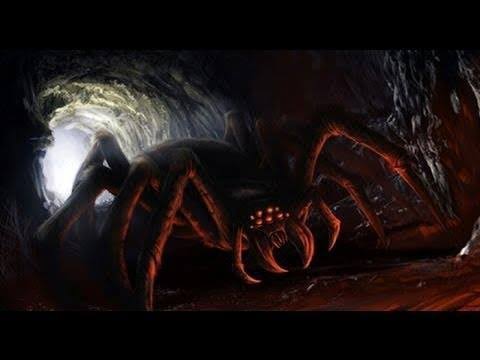
J’ba Fofi means “giant spider” and pops up mostly in stories from the Congo region, especially among the Baka people. And these aren’t just your run-of-the-mill big tarantulas. The creatures folks describe are way beyond what anyone would expect a thick, hairy body and legs that stretch out feet across.
And these stories don’t line up exactly, either. Some mention a brown or tarantula-like spider, others talk about something jet black and shaggy. Sometimes there’s a web; sometimes it’s just a massive spider strolling across a path.
The most interesting part, though, is the people behind these J’ba Fofi sightings.
The Lloyds Congo, 1938
Probably the most famous sighting comes from Reginald and Margurite Lloyd. Back in 1938, they were cruising through what was then the Belgian Congo in a Ford truck. Suddenly, something darted across the track in front of them.
At first, they thought it was just an ordinary animal. Maybe a cat or a monkey. Reginald even stopped the truck and waited for the thing to move along. But as they got a better look, they realized this was no regular animal it was a massive spider.
Depending on who’s retelling the story, the spider had a leg span somewhere between three and five feet. Not a typo feet. Some say the Lloyds tried to snap a picture, but back in those days, you couldn’t just pull out your phone. By the time they grabbed their camera, the spider had already vanished into the brush.
What I find cool is that this wasn’t some internet rumor cooked up in the ‘90s. The story passed down through their family until cryptozoologist William J. Gibbons eventually heard it.
This single sighting is probably why the J’ba Fofi got attention outside its original folklore.
The Baka Accounts
The other set of stories always comes from the Baka people themselves, living right in the Congolese forests. That matters because it means the J’ba Fofi wasn’t just made up for some spooky book.
During his trips to Central Africa, Gibbons collected lots of Baka accounts about hulking spiders that nest around tree roots, blend in with leaves, weave thick strands between trees, and get this even have eggs the size of peanuts. Some people described baby spiders as yellowish with a purple belly; adults turned darker brown as they grew.
No photos, no specimens, but the Baka’s details are oddly specific so much more than just “there’s a giant spider out there!”
Timbo and the Cameroon Report
One of the more modern stories comes from Cameroon. During his research, Gibbons talked to a Baka chief named Timbo. In November 2000, Timbo said a J’ba Fofi had built a nest close to his village. People there acted like “Yeah, those things exist.” So, it’s not just some tourist spotting something freakish it’s part of the local world.
The key difference here? The Lloyds saw their spider in a flash and probably never again. The Baka treat these spiders like a known part of the forest ecosystem.
Arthur Simes and the Uganda Story
There’s another tale, usually floating around cryptid websites, involving Arthur Simes, an English missionary in Uganda in the late 1800s. According to this somewhat sketchy account, he and his group found themselves tangled in giant spider webs, and supposedly Simes was even bitten and died.
Honestly, this one feels flimsy. Nobody can seem to confirm the original source, and a lot of folks question whether the expedition really happened. I wouldn’t put this near the Lloyd account for credibility, but it’s out there, and often repeated.
The Australian Soldier Papua New Guinea, 1942
On the other side of the world, there’s a report from an unnamed Australian soldier in Papua New Guinea during WWII. He claimed to see a spider about the size of a puppy, black and hairy, living in a gigantic web that stretched ten to fifteen feet across. It’s not Africa, but it’s another story that pops up when people talk about giant spiders.
Whether it’s the same thing as the J’ba Fofi is up in the air. Maybe every now and then, someone sees a super-sized spider and the story grows taller over time.
William Slaydon and the 1948 Louisiana Sighting
Here’s one of my favorites probably because it’s so unexpected. In 1948, William Slaydon, his wife Pearl, and their grandsons were walking along Highway 171 near Leesville, Louisiana. Suddenly, Slaydon spotted movement in a ditch and told the kids to wait. Out came a black, hairy spider the size of a washtub. The spider crossed the road and disappeared into the brush.
No drama, no attacks, just a giant spider being a spider. That’s what makes it feel real to me. Plus, you’ve got a whole group of people, kids and adults, who swear they saw it. This story made its way down through the family, eventually reaching cryptozoology circles. Louisiana is a long way from the Congo, but it fits the pattern strange creatures popping up in the unlikeliest places.
The Black Hills Report 1969
In 1969, a woman driving in the Black Hills of South Dakota saw a spider so huge it supposedly spanned the width of a lane. Not a lot of details here, though. It ends up lumped in with the rest, but it’s far from the strongest case.
The Cambodia Report 1970
Then you’ve got this really wild story from Cambodia in 1970. A Green Beret, whose name isn’t givThe Lloyds Congo, 1938en, was on a mission when he caught sight of something moving in the vegetation. Through night vision, he saw what he thought was a person, but it turned out to be a spider, supposedly the size of a small ATV. The thing vanished almost instantly.
I’d take that size estimate with a heap of skepticism. Night, stress, and night vision goggles can all mess with your sense of scale. Still, the Green Beret was expecting to see a person, not some gigantic spider, which is a pattern you see a lot people just don’t expect spiders that big.
Who Actually Saw the J’ba Fofi?
Cutting through all the noise, the core names behind these sightings are:
– Reginald and Margurite Lloyd, who gave us the famous 1938 Congo story.
– William J. Gibbons, who never claimed to spot the spider himself but did a lot to gather reports, especially from the Baka people.
– Timbo, the Baka chief in Cameroon who talked about a spider nest near his village in 2000.
– William and Pearl Slaydon, plus their grandkids including Richard Partain, who passed the Louisiana story on.
– Then you get the less clear-cut witnesses: the unidentified Australian soldier in Papua New Guinea, the unnamed woman in the Black Hills, and the anonymous Green Beret in Cambodia.
– And of course, Arthur Simes, whose tale is probably more campfire story than historical fact.
But here’s the problem none of these stories comes with what everyone actually wants: solid evidence. No body. No bones. No crystal-clear photo. Nobody ever caught one, dragged it into town, or filmed it crossing a path. All we have are scattered stories, covering decades and continents.
The Lloyds’ account feels like the main event: two named witnesses, a place, and a specific moment in time. The Baka provide depth, showing that these legends are older than the internet. The Slaydon story just adds to the weird spread of eerily similar sightings well outside Africa.
But no matter how many stories stack up, it’s not the same as proof. That’s what makes all of this so compelling to me. If someone had snapped that perfect photo of a four-foot spider standing next to a truck, the whole mystery would disappear.
Instead, we get these fleeting moments: something enormous crosses a road, disappears into the undergrowth, and leaves a handful of people bewildered.
Just like the Lloyds: they stopped the truck, watched a giant spider scurry across, and then poof it was gone.
Nobody caught it. Nobody got a picture. Yet here we are, decades later, still talking about it.