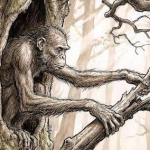
The Gumberoo was completely new to me. I found it by accident while hopping from one strange folklore story to another, following one creature after the next until I ended up reading about this odd thing called a “Gumberoo.”
At first, it sounds like a joke.
A giant black animal living in the North Woods. Completely hairless. Its skin is supposedly so tough that bullets, axes, rocks, and pretty much anything else thrown at it can come flying back at whoever threw them. And just when you think the story can’t get any stranger, you find out that the creature’s biggest weakness is fire.
Yeah. Fire.
The more I looked into Gumberoo folklore, though, the more interesting it became. This isn’t really the same kind of story as a modern internet cryptid. The Gumberoo belongs to the old tradition of American fearsome critters, especially the exaggerated stories told around logging camps.
And honestly, some of those old lumberjack stories are much stranger than the monsters people invent today.
What Is the Gumberoo?
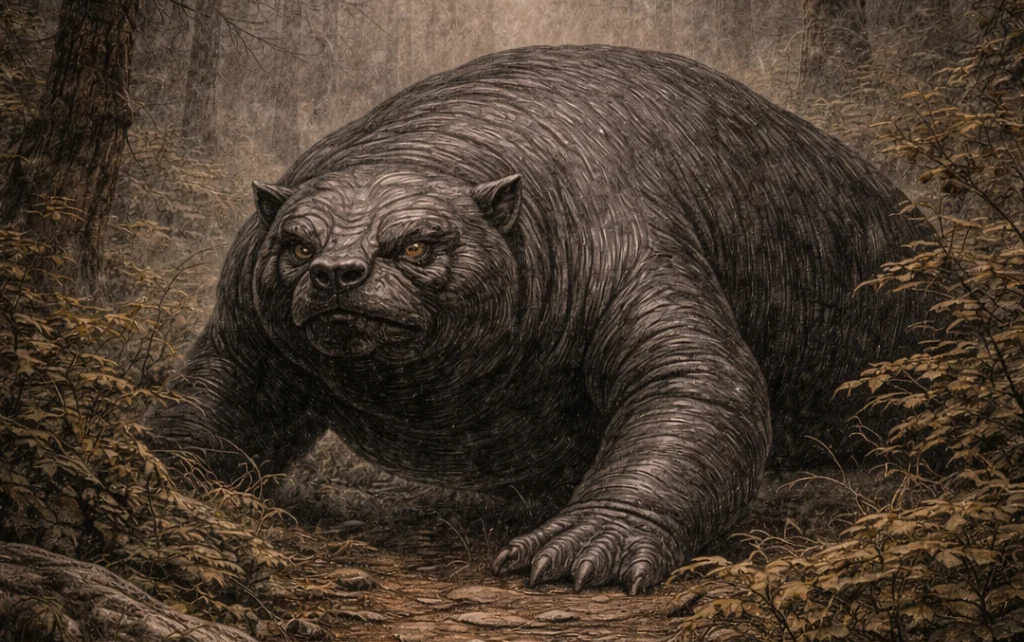
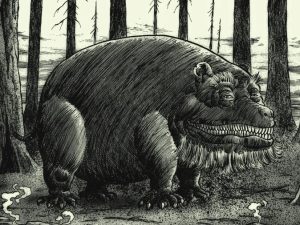
The Gumberoo is a legendary creature from North American lumberjack folklore, usually described as a huge, black, bear-like animal with an almost completely hairless body.
Imagine taking a bear, removing most of its fur, making its body rounder and heavier, covering it in something resembling black rubber, and then giving it an attitude problem.
That’s basically the Gumberoo.
Old descriptions give it a thick, barrel-shaped body supported by short but powerful legs. Its hide is supposed to be smooth, dark, and incredibly elastic. It isn’t described as looking like normal skin. Instead, the thing supposedly has a surface more like hardened pitch or rubber.
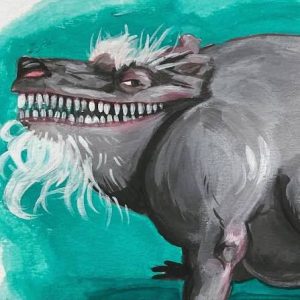
Some versions mention a few coarse hairs around its chin and unusually prominent eyebrows. Others add a reddish stripe of hair running along its back.
The details change depending on who’s telling the story, which is pretty normal for American folklore. One lumberjack might describe the creature one way, another might add something completely ridiculous, and after a few retellings you’ve got a monster that sounds like it was designed by a bored guy sitting beside a campfire.
But the basic idea stays the same.
Big.
Black.
Almost impossible to hurt.
And apparently not something you want wandering around your camp.
The Gumberoo’s Strange Hide
This is probably the part of the Gumberoo creature legend that made it stick around.
According to the stories, ordinary weapons don’t work against it.
A hunter shoots at the Gumberoo?
The bullet bounces back.
Someone throws a rock?
It comes right back.
An angry lumberjack swings an axe?
The axe doesn’t cut the animal. Instead, the blow rebounds, potentially sending the weapon — or the person holding it — in the opposite direction.
That makes the Gumberoo different from a lot of other fearsome critters.
Most legendary animals are dangerous because they’re strong, fast, poisonous, huge, or just plain hungry.
The Gumberoo doesn’t need any of that.
Its defense is basically:
“Good luck hurting me.”
William T. Cox’s early description of the creature pushed this idea to an almost absurd level, describing its elastic hide as capable of throwing back everything from charging animals to objects hurled by people.
It’s ridiculous.
That’s also the point.
The old logging stories weren’t trying to create scientifically believable animals. They were tall tales, and the bigger the claim, the better the story.
Where Does the Gumberoo Live?
The usual answer is somewhere deep in the North Woods.
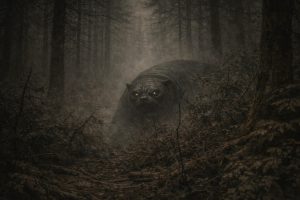
The Gumberoo is associated with old forests, particularly enormous trees with hollow interiors. Some versions specifically connect it with fire-damaged or lightning-struck trees.
That makes the creature feel strangely at home in the environment where the stories originated.
Think about the setting.
You’re working in a remote logging camp. There’s dense forest in every direction. Huge trees are being cut down. There are old hollows, fallen timber, strange animal sounds, smoke from campfires, and plenty of things nobody has time to investigate.
Then someone tells you there’s a giant black animal sleeping inside a hollow cedar.
Would you check?
Probably not.
The creature is sometimes described as living inside trees rather than making an ordinary den on the ground. That detail also appears to explain why nobody ever finds one.
If the Gumberoo is hiding inside some enormous hollow tree miles from civilization, there isn’t exactly going to be a convenient sign saying:
GUMBEROO DEN — KEEP OUT.
Gumberoo Behavior and Abilities
The Gumberoo’s behavior is usually less dramatic than you’d expect.
It isn’t constantly chasing people.
In most versions, it’s solitary and territorial. It spends much of its time moving slowly through the forest or staying inside its shelter.
That actually makes the stories better.
A monster that is always screaming and attacking everything becomes predictable.
The Gumberoo doesn’t seem to care about people unless someone bothers it.
And apparently lumberjacks were very good at bothering things.
Once disturbed, the animal is supposed to become aggressive very quickly. Its combination of enormous strength and nearly indestructible hide makes it a serious problem for anyone unlucky enough to encounter one.
Some stories also describe the Gumberoo as surprisingly agile despite its bulky body. It can supposedly move through thick woodland and climb trees more easily than something that looks like a giant barrel should be able to.
That contradiction is another common feature of fearsome critter stories.
The creature looks ridiculous until it starts doing something ridiculous that is also somehow terrifying.
What Does the Gumberoo Eat?
This part gets weird too.
Some versions give the Gumberoo a fairly ordinary carnivorous or omnivorous diet. Small animals, forest creatures, anything it can catch — basically the usual stuff.
Other stories make the animal much more ridiculous.
There are claims that it eats wood.
Not bugs inside wood.
Not bark.
Actual wood.
Whole pieces of timber supposedly disappear into its enormous mouth.
This is exactly the kind of detail I expect from lumberjack folklore. If you’re spending months surrounded by trees, why not invent a monster that eats them?
Other versions suggest it feeds on animals such as porcupines and raccoons and may even raid camps when food is available.
The important thing isn’t really the diet.
It’s the atmosphere.
The Gumberoo belongs to a forest where normal rules have been slightly switched off.
The Gumberoo’s One Big Weakness: Fire
Here’s where the legend gets especially strange.
For something supposedly capable of shrugging off bullets and axes, the Gumberoo has one spectacular weakness:
fire.
The same hide that protects it from almost everything else is said to be highly flammable.
Some stories explain this by claiming the animal’s body contains enormous amounts of combustible gas. Others simply treat the creature’s pitch-like skin as something that catches fire easily.
Either way, the result is basically the same.
A spark hits the Gumberoo.
The Gumberoo catches fire.
Then things get very bad.
According to the old stories, the creature can explode violently, leaving behind a scorched patch of ground, an unpleasant smell, and very little evidence that the animal was ever there.
And that last part is convenient.
No skeleton.
No giant skull.
No preserved hide.
Nothing.
Just a burned area in the woods.
If you’re telling a tall tale about an impossible animal, that’s a pretty effective way to end it.
Why Fire Matters in Gumberoo Folklore
The Gumberoo fire story isn’t just a random weakness.
It fits the world of the people who told these stories.
Logging camps depended heavily on fire. Cooking, heating, lighting and working around dry timber all carried obvious risks.
A creature that is supposedly impossible to kill but dangerously vulnerable to fire turns the whole thing into a joke with a practical warning underneath.
Don’t be careless with fire.
Especially not in a forest full of dry timber.
So even though the Gumberoo itself is ridiculous, there is something recognizable underneath the story.
The woods are powerful.
The woods are dangerous.
And sometimes the thing you think makes you safe can become the thing that gets you into trouble.
Gumberoo and Lumberjack Lore
This is where I think the Gumberoo becomes more interesting than a lot of modern cryptids.
Modern cryptid stories often revolve around sightings.
Someone sees something.
They take a blurry photograph.
Someone else analyzes the photograph.
Then the internet argues about it for ten years.
The Gumberoo lumberjack folklore tradition works differently.
The story wasn’t necessarily meant to convince everyone that a new species had been discovered.
It was entertainment.
It was exaggeration.
It was the kind of story that could make a long night at a remote logging camp more interesting.
The same tradition produced all sorts of bizarre fearsome critters, many of which had impossible physical characteristics or ridiculous habits.
The Gumberoo fits perfectly into that world.
It’s too strange to be a normal animal and too deliberately exaggerated to feel like a straightforward monster report.
That’s probably why it survived.
Gumberoo Encounters
Actual Gumberoo sightings are obviously difficult to separate from folklore.
Modern reports usually follow a familiar pattern.
Someone claims to have seen a large dark animal in the woods.
Sometimes it’s moving low to the ground.
Sometimes it’s partially hidden behind trees.
Sometimes the witness reports strange sounds or unusual damage nearby.
And occasionally a story connects the sighting with a burned or disturbed patch of forest.
The problem is that none of this gives us physical evidence.
There are no verified Gumberoo remains.
No confirmed photographs.
No DNA.
No reliable specimen.
As far as science is concerned, the Gumberoo remains a legendary animal.
But that doesn’t mean modern sightings are completely uninteresting.
Folklore has a habit of changing as it travels. An old lumber camp story can disappear for decades and then suddenly reappear in books, forums, local legends, or cryptid communities.
The creature doesn’t necessarily have to be real for the story to keep evolving.
Gumberoo Wisconsin, Michigan, and Minnesota
The creature is commonly associated with the northern forests of the United States, and modern discussions often place the Gumberoo Wisconsin connection alongside Michigan and Minnesota.
That makes sense geographically and culturally.
The Great Lakes region has a long history of logging, isolated camps, enormous forests, and local tall tales. The Gumberoo North Woods setting fits naturally into that landscape.
You’ll sometimes see the creature described as a Wisconsin monster, a Michigan forest creature, or something hiding somewhere in Minnesota.
But pinning down one exact location isn’t really how the folklore works.
The Gumberoo is more of a regional creature than a monster with a specific address.
Its real habitat is the old lumber camp story.
Is the Gumberoo a Cryptid?
This is where things get slightly complicated.
The Gumberoo is often called a Gumberoo cryptid today, especially on websites and forums that group legendary creatures together.
Technically, though, it’s better understood as a fearsome critter from American lumberjack folklore.
That distinction matters.
A cryptid is generally presented as an animal whose existence is claimed but hasn’t been scientifically established.
A fearsome critter is something else.
These creatures were often deliberately invented or exaggerated as part of storytelling traditions among woodsmen, hunters, and lumber workers.
So calling the Gumberoo a cryptid isn’t necessarily wrong in modern popular culture, but it can make the original tradition look more like a modern mystery than it really was.
The Gumberoo was never just “Bigfoot but black.”
It came from a completely different storytelling tradition.
Was the Gumberoo Part of Native American Folklore?
This is one claim I’d be careful with.
You can find modern websites describing the Gumberoo as part of Indigenous folklore, but the creature is much more securely connected to American lumberjack and logging-camp traditions.
There isn’t a good reason to automatically label every strange North American forest creature as Indigenous folklore.
The documented Gumberoo folklore tradition is closely associated with the old fearsome-critter literature and lumber camps.
That’s actually more interesting anyway.
The story tells us something about the people who created it.
They worked in dangerous forests, lived far from towns, dealt with unpredictable weather and fire, and spent a lot of time entertaining themselves with stories.
The Gumberoo feels like exactly the kind of monster that environment would produce.
Why the Gumberoo Still Gets Talked About
I think the reason the Gumberoo has survived is pretty simple.
It’s weird.
There are thousands of legendary creatures that are basically giant wolves, hairy men, dragons, ghosts, or giant snakes.
The Gumberoo isn’t any of those.
It’s a black, rubber-skinned forest animal that apparently can’t be shot, can’t be chopped, and can explode if somebody gets too close with a flame.
That’s hard to forget.
The story also has a good built-in contradiction.
The Gumberoo is almost impossible to kill.
But it has one extremely stupid weakness.
That makes the creature funny without making it completely harmless.
And that’s a surprisingly difficult balance to get right.
The Gumberoo Legacy
The Gumberoo legend belongs to an older version of American storytelling, when a monster didn’t need a realistic explanation or a grainy photograph to become memorable.
It just needed a good story.
The creature has everything a proper fearsome critter needs: a ridiculous appearance, an impossible ability, a strange weakness, a remote habitat, and just enough danger to make the listener wonder whether they should actually believe it.
Do I think there’s a giant black animal hiding inside a hollow cedar somewhere in Wisconsin?
No.
But I also wouldn’t volunteer to crawl into an enormous hollow tree in the middle of the North Woods just to prove a point.
That’s probably the best thing about the Gumberoo.
You can laugh at the story.
You can recognize it as lumberjack folklore.
You can call it a cryptid if you want.
And yet, when you’re walking through a dark stretch of forest and hear something heavy moving behind the trees, part of your brain is still going to remember the stupid black bear that supposedly sends bullets back at people.
That’s what makes old folklore work.
The story doesn’t have to be true.
It just has to stay in your head.