Hello, fellow nature and mystery enthusiasts! Today, I’m taking you into the dark, gloomy forests of North America. You know those stories told around a campfire, the ones you swear must be true, even though they were probably made up by some lumberjack? Well, today I’m going to introduce you to one of them: the Agropelter. I can almost hear you asking, “Agro-what?” Fair enough. The name sounds a bit like some kind of farming tool, but this creature is supposedly one of the most mischievous, sneaky, and perhaps funniest legendary creatures lurking in the woods.
Who Is the Agropelter?
The Agropelter is one of the more aggressive members of the legendary menagerie known as the “Fearsome Critters” of North America. It’s also supposedly known by the playful Latin name Anthrocephalus craniofractens, a name scientists supposedly gave it as a joke. The word craniofractens, meaning “skull breaker,” pretty much sums up its main area of expertise.
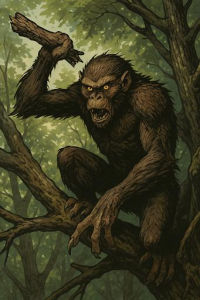
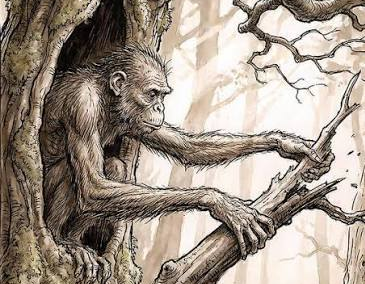
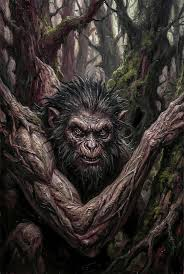
So, what exactly does this thing look like? Very few people have ever seen one, and those who have supposedly weren’t in the best condition to describe it after getting hit on the head. Still, the descriptions tend to agree on a few things: a thin, wiry body, a nasty-looking monkey-like face, and long, muscular arms like whips. Some describe it as having a gorilla’s head, while others compare it to a stretched-out, starving bear. Its fur is said to be completely black, but its face supposedly has a gray, skull-like pattern. So, if you ever spot a gray face staring at you from a tree hollow in the darkness, chances are you’re in serious trouble.
Why Is It Always Throwing Things?
Here’s the main thing that sets the Agropelter apart from other legendary creatures: its incredible talent for throwing things at people.
The moment this creature spots a lumberjack, camper, or unlucky traveler walking through the forest, it supposedly springs into action. But its weapon isn’t a rifle or a set of claws. It’s dead, dried-out branches, chunks of wood, and pinecones. With those whip-like arms, it can supposedly snap off branches and hurl them with such force that they fly through the air like six-inch cannonballs.
The Agropelter’s greatest pleasure is apparently waiting for someone to walk beneath a tree without noticing it, then dropping a heavy piece of wood right onto their head with a satisfying thunk.
There’s an old joke among lumberjacks about this. If a man is found unconscious in the forest with a wound on his head, the official report simply says, “Struck by a falling tree branch.” But everyone knows the real story: the Agropelter cryptid got him.
There’s even supposedly one recorded survivor who lived to tell the tale: Big Ole Nittleson. While searching for timber around the St. Croix area, Ole was struck on the head by a rotten branch thrown by an Agropelter. Luckily for him, the branch was so decayed that it crumbled apart when it hit his head. That gave Ole a chance to see the creature before losing consciousness, leaving us with that famous description of its whip-like arms and monkey face.
Its World: Where Does It Live, and What Does It Eat?
The Agropelter usually lives inside the hollow trunks of old, dead trees. These hollows serve as both its home and its perfect hiding place for ambushing unsuspecting victims.
Geographically, its supposed territory covers a surprisingly large area. From Maine in the northeastern United States all the way west to Oregon, the creature is said to inhabit coniferous forests across much of North America. In other words, almost the entire northern forest region is supposedly its kingdom.
But what does this grumpy creature actually eat? Its main menu consists of owls and woodpeckers. Since these birds can be difficult to find in the forest, their limited availability supposedly keeps the Agropelter population under control. It’s also said to nibble on something called “dozy wood,” meaning rotten timber.
So, in a way, the Agropelter doesn’t attack humans because it’s hungry. It simply seems to hate them. Its attacks are supposedly driven by pure enjoyment and an instinct to defend its territory.
The Origin of the Legend: A Lumberjack’s Devilish Joke
So, why would anyone invent a creature like this in the first place?
The truth is that the Agropelter legend is less of a traditional horror story and more of an excuse for workplace accidents. During the late nineteenth and early twentieth centuries, lumber camps across North America were dangerous places to work. One particular hazard was what lumberjacks called a “widowmaker,” a dead branch that suddenly falls from a tree and can easily kill someone standing below.
That’s where the Agropelter legend comes in.
Lumberjacks could explain these unfortunate accidents by claiming that an invisible creature had attacked them. At the same time, they could tease one another by saying, “Watch out. The Agropelter might be watching you.”
These stories survived through oral tradition until William T. Cox collected them in his 1910 book, Fearsome Creatures of the Lumberwoods.
One of the funniest details about the Agropelter concerns its reproductive habits. According to legend, its young are born only on February 29, during leap years, and always in odd-numbered quantities: one, three, five, seven, and so on. That makes the creature something of a calendar-related oddity, too.
Final Thoughts: Respect the Forest, or Else…
The Agropelter is really a symbol of nature’s mischievous anger toward humans. It reminds us that when we’re walking beneath the shadow of a hollow tree, a pinecone falling on our heads might not necessarily be the work of a bird.
Maybe, deep in the forest, that gray-faced, whip-armed creature is still hiding somewhere, waiting for its next unlucky visitor, with a hefty branch in its hands and a clear shot in mind.
The next time something falls on your head while you’re walking through the woods, don’t immediately blame a clumsy squirrel. Maybe the Agropelter was just saying hello.
Just remember, its version of a friendly greeting can hurt a little.
Respect the forest, and keep your eyes on the trees above you. Who knows? Maybe one day you’ll catch a glimpse of it, just like Big Ole, and finally discover for yourself how much truth there is to this strange old story.
Sources and Further Reading
Cox, William T. (1910). Fearsome Creatures of the Lumberwoods. The original account of the Agropelter, including its appearance, behavior, and lumberjack folklore. Read the Agropelter entry
Tryon, Henry H. (1939). Fearsome Critters. A later collection of North American lumberjack folklore featuring additional details about the Agropelter. Read the Agropelter entry