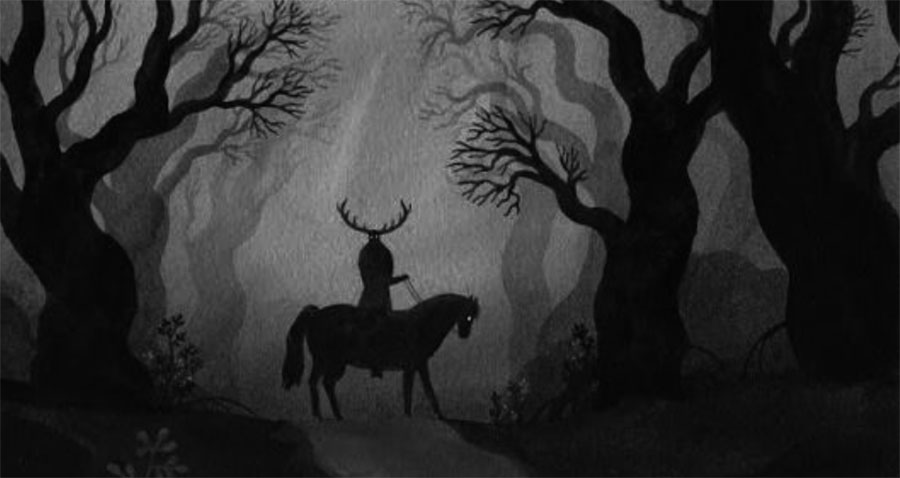
Some folklore stories are easy to picture. You hear the story once and the image stays with you. Herne the Hunter is a good example.
He’s usually described as a ghostly huntsman with antlers growing from his head, riding through Windsor Forest at night with a pack of phantom hounds. Sometimes a hunting horn can be heard in the darkness. In older versions of the story, hearing that horn was considered a bad omen.
There are plenty of strange characters in English folklore, but Herne is particularly interesting because his origins are so unclear. We know he was associated with Windsor Forest by the time Shakespeare wrote about him in the 1590s. Beyond that, things get much murkier.
Was Herne originally a ghost story? Could there be something much older behind the antlered figure? Or did several different traditions eventually become mixed together?
The more you look into Herne, the harder it becomes to separate fact from folklore.
Who Exactly Was Herne?
Herne is traditionally associated with Windsor Forest and the Great Park around Windsor Castle.
Descriptions of him vary, but the basic picture is familiar. He’s a supernatural huntsman, often shown with antlers on his head, riding a dark horse through the forest. A group of ghostly hounds may follow him, and the sound of his hunting horn is sometimes said to announce misfortune or death.
The antlers are obviously the most unusual part.
A hunter wearing antlers isn’t exactly an ordinary image, even by folklore standards. It makes Herne look neither completely human nor completely animal, which may be one reason the character has remained so memorable.
And then there’s the forest itself.
Windsor has been associated with hunting and royal forests for centuries, so a supernatural huntsman appearing there isn’t a particularly surprising idea. In fact, the setting probably helped the legend survive.
Herne and Shakespeare
The earliest famous written reference to Herne comes from William Shakespeare’s The Merry Wives of Windsor, written around the end of the sixteenth century.
In the play, Herne is described as a former huntsman who supposedly appears around an old oak tree in Windsor Forest at midnight. He’s said to wear antlers and to frighten people who encounter him.
Later in the play, Falstaff is tricked into dressing up as Herne, complete with antlers. It’s a humorous scene, but the reference itself tells us something important.
Shakespeare’s audience apparently didn’t need much explanation of who Herne was.
The play treats him as a local legend that people already knew. Shakespeare doesn’t stop to introduce some completely unknown supernatural character. He simply uses Herne as part of the story.
That suggests there was probably an existing tradition behind the character.
Unfortunately, we don’t have an earlier written account telling us what that tradition looked like.
The Herne the Hunter Story
The most popular version of the Herne the Hunter story is considerably darker than Shakespeare’s comedy.
According to the legend, Herne was a royal gamekeeper who served King Richard II.
During a hunt, a large stag supposedly charged at the king. Herne intervened and saved Richard’s life, but the animal seriously injured him with its antlers.
After the accident, Herne supposedly lost his abilities as a hunter. Other keepers became jealous and eventually accused him of poaching.
Herne was disgraced.
Unable to deal with what had happened, he supposedly hanged himself from an oak tree.
And that’s where the story takes its supernatural turn.
After his death, Herne returned to the forest as a ghostly huntsman. He appeared with antlers on his head and rode through the woods with a pack of spectral hounds.
The oak where he supposedly died became known as Herne’s Oak.
It’s a great ghost story, although there’s no reliable historical evidence that this particular gamekeeper actually existed. The detailed version of his story appears in later traditions, so it’s difficult to know how much of it belongs to the original legend.
Still, the story explains something that otherwise seems rather strange: why would a ghostly English huntsman have antlers?
The Antlers May Be Older Than Herne
This is where things get more complicated.
Herne’s antlers have often led people to compare him with older horned figures from European mythology.
The most obvious comparison is Cernunnos, the ancient Celtic figure usually depicted with antlers. Cernunnos is associated with animals and the natural world, although our knowledge of the actual beliefs surrounding him is limited.
There are also similarities between Herne and the Wild Hunt.
The Wild Hunt is a widespread European tradition about supernatural hunters travelling through the night. Different versions have different leaders, including Odin or Woden, and the hunt is often connected with death, storms or other supernatural events.
A ghostly hunter, supernatural dogs and a nighttime ride through the wilderness certainly sound familiar in that context.
This is where searches for Herne the Hunter pagan origins usually lead. The similarities with older horned figures are interesting, but they don’t automatically prove that Herne himself was a pagan deity.
You’ll sometimes see Herne described as though historians have already established that he was an ancient pagan god who was later turned into a ghost.
That’s much more certain than the evidence allows.
There are similarities, but we don’t have a clear chain of evidence connecting Herne directly to Cernunnos or the Wild Hunt. It’s possible that older traditions influenced the legend. It’s also possible that the similarities developed independently.
The truth may simply be impossible to recover now.
What Happened to Herne’s Oak?
The oak tree associated with Herne is another interesting part of the story.
According to tradition, Herne appeared around an ancient oak in Windsor Forest. Over time, particular trees were identified as Herne’s Oak, although there’s no way to know whether any of them was actually connected with the original story.
One famous tree known as Herne’s Oak stood near Windsor Castle and was eventually removed in the eighteenth century.
By then, the legend was already well established.
There’s something very typical about this part of the story. Folklore often becomes attached to physical places. An old tree, a ruined building or a particular stretch of forest can become the setting for a story, and eventually the place itself becomes part of the legend.
Once that happens, the story becomes much harder to forget.
Is Herne the Hunter a God?
The question is Herne the Hunter a god has become increasingly common as modern interest in mythology has grown.
The short answer is that there is no good historical evidence that Herne was worshipped as a god.
Unlike Cernunnos, there is no known ancient inscription, religious site or archaeological evidence showing that people worshipped Herne as a deity. The surviving tradition presents him primarily as a supernatural huntsman associated with Windsor Forest.
That doesn’t rule out the possibility that the legend contains elements inherited from older beliefs. It simply means we shouldn’t treat that connection as established fact.
Modern fantasy and pagan interpretations have also changed the way Herne is viewed. Some portray him as a powerful forest deity or guardian of the wild, which is quite different from the ghostly huntsman found in the English tradition.
Herne in Modern Fantasy
Herne didn’t disappear with the old stories.
He’s been used in modern books, television shows, comics and fantasy stories, sometimes looking very much like the original ghostly huntsman and sometimes becoming something quite different.
One of the best-known modern versions appeared in the BBC series Robin of Sherwood. There, Herne is portrayed as a mysterious guardian of the forest and becomes closely connected with Robin Hood.
This version is much less like a traditional ghost and much more like an ancient supernatural figure.
Other writers have taken the same idea in different directions. Herne can be a frightening hunter, a protector of the woods or a symbol of an older world that existed before modern civilization.
The character works particularly well in fantasy because the basic image is already so strong.
You don’t really need to change much.
Give him antlers, a horse, a dark forest and a pack of ghostly dogs, and the character is immediately recognizable.