We’re looking at the Gelert the dog story, a tale that has been told for centuries and serves as a powerful, if painfully sad, reminder of what happens when we let fear override our trust in those who love us most.
Now, I know what you’re thinking. A story about a dog? I’ve read Old Yeller. I’ve seen Marley & Me. I know how this ends. But the legend of Gelert is different. It’s not just about a dog’s loyalty; it’s about a human’s terrible mistake. It’s a story that’s part of the very fabric of Wales, a tale whispered in the shadow of Snowdonia’s mountains. So, grab a cup of tea (or something stronger, you might need it), and let’s unpack this legendary tale.
The Setting: A Prince, a Palace, and a Perfect Pup
Our story begins in medieval Wales, in a beautiful corner of the country. The ruler of this land was Llywelyn the Great, a powerful and respected prince. Llywelyn was a busy man uniting Wales, fighting off English kings, the usual medieval prince stuff. But he had a sanctuary: his home, and within it, his family. He had a loving wife and, most importantly, a young son and heir, a little boy who was the light of his life.
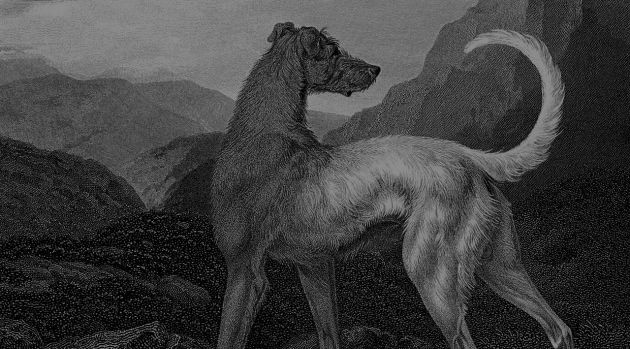
To protect this precious boy, Llywelyn had a constant companion, a loyal guardian who was more than just a pet. This was Gelert, his faithful hound. Gelert wasn’t just any dog; he was a magnificent, powerful Irish Wolfhound, a gift from the King of Ireland. He was Llywelyn’s best friend, his shadow, and the self-appointed bodyguard of the young prince. The bond between the prince and his dog was a thing of legend. Where the boy went, Gelert was sure to follow, a gentle giant with a heart as big as the mountains surrounding their home. He was the goodest boy, a canine knight in furry armor.
The Hunt and the Horrible Homecoming
One crisp autumn morning, the call of the hunt echoed through the valleys. Llywelyn, like any nobleman of his time, was an avid hunter. The horns blew, the horses whinnied, and the pack of hunting dogs barked with excitement. Llywelyn prepared to leave, but as he did, he noticed Gelert was not at his side, whining to join the chase. Instead, the great hound was restless, pacing near the door to the prince’s nursery. He seemed reluctant to leave his post. Llywelyn, understanding the dog’s dedication, decided to let him stay. “Guard the boy, Gelert,” he might have said, a simple command to a friend he trusted implicitly.
With a final wave, the prince rode off, leaving his wife, his son, and his loyal dog behind. The hunt was long and arduous, a successful day in the wild forests. As the sun began to dip below the horizon, casting long shadows across the land, Llywelyn and his party returned home, tired but triumphant. The sounds of laughter and conversation filled the courtyard as they dismounted.
Llywelyn, eager to see his family, strode into the great hall. But an eerie silence greeted him. The usual sounds of the household were absent. A knot of unease tightened in his stomach. He called out for his wife, for his servants. No answer. A cold dread began to creep into his heart. His first thought was for his son.
He rushed to the nursery, his heart pounding against his ribs. He pushed open the heavy wooden door and froze, his blood turning to ice.
The room was a scene of absolute chaos. The heavy wooden cradle where his son slept was overturned, its blankets and furs scattered across the floor. The air was thick with a metallic smell he knew all too well. And there, standing over the wreckage, was Gelert. The dog’s muzzle and powerful jaws were stained a dark, deep red. His chest was smeared with blood. As he saw his master, Gelert wagged his tail weakly, a look of exhaustion, not guilt, in his eyes.,
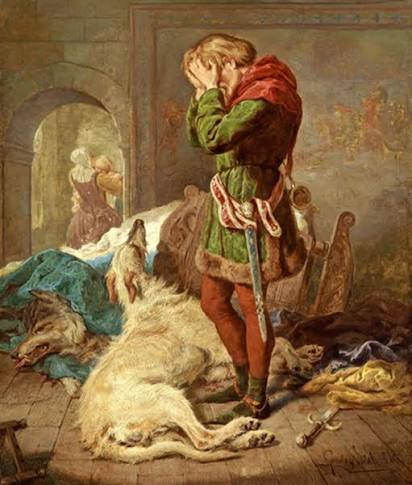
But Llywelyn didn’t see a tired guardian. He saw a blood-soaked beast. He saw the empty cradle. He saw the proof of his worst nightmare. In that split second, a red mist of rage and grief descended upon him. The rational part of his mind, the part that knew Gelert would never harm the boy, was silenced by a primal, overwhelming scream of parental terror.
“You monster!” he roared, the words tearing from his throat. He didn’t look for his son. He didn’t hear the faint, gurgling sounds from the corner of the room. All he saw was the blood and the dog. Consumed by a terrible, blind fury, he drew his sword. Before he could think, before he could question, he plunged the blade into the heart of his most loyal friend.
Gelert let out a single, tragic yelp—not of pain, but of betrayal—and collapsed at his master’s feet. The great hound’s eyes looked up at Llywelyn, not with anger, but with a profound sadness, before the light within them faded forever. The silence that followed was deafening, broken only by the sound of Llywelyn’s ragged breathing.
The Discovery That Broke a Prince
As the adrenaline began to fade, Llywelyn’s rage was replaced by a cold, creeping horror. The room was quiet now, but it wasn’t the silence of an empty room. A faint cry, barely a whimper, came from beside the overturned cradle. His heart seized. He stepped over Gelert’s still body and peered into the shadows.
There, nestled between the cradle and the wall, was his son. Alive. Unharmed.
He scooped the boy into his arms, tears of relief streaming down his face. But his relief was short-lived, as his eyes fell upon something else in that dark corner. Lying behind the child was the body of a massive, grey wolf. Its throat was torn out, its body savaged, and it was very, very dead.
The truth crashed down on Llywelyn with the force of a tidal wave. The blood on Gelert’s jaws wasn’t his son’s. It was the wolf’s. In the absence of his master, Gelert had defended the prince from the most ferocious of predators. He had fought a battle to the death and won. He had saved the boy’s life.
The blood on the cradle was from the struggle. The overturned furniture was a testament to the violence of the fight. And Gelert, his loyal, heroic Gelert, had stood over the child he had saved, wagging his tail not in guilt, but in a moment of exhausted pride, welcoming his master home. He had been waiting for praise, for a pat on the head, for the acknowledgement of a job well done.
Instead, he received a sword through the heart.
The legend says that Llywelyn never smiled again. The grief that washed over him was an ocean of regret so deep and so dark it consumed his soul. He had killed the very creature that had saved his most precious gift. The story of Gelert the dog became a story of Llywelyn’s eternal shame.
The Legend Lives On: Beddgelert
Llywelyn, in his profound sorrow, buried Gelert with all the honours of a fallen hero. He built a grand stone cairn over his grave, a monument to his faithfulness. And there, at the site of the grave, a small village grew. The village was named Beddgelert, which in Welsh means “Gelert’s Grave.” To this day, you can visit the supposed grave of this legendary hound in the beautiful village of Beddgelert in Snowdonia. It is a place of pilgrimage for dog lovers and lovers of tragic stories from all over the world.
Is the story true? Historians will tell you it’s likely a folktale, a myth that echoes similar legends from other cultures (like the Indian story of the mongoose and the baby). It was popularized in the 18th century by a local innkeeper who wanted to attract tourists. And boy, did it work! But the historical truth doesn’t matter. The emotional truth of the story resonates across centuries. Gelert the dog story isn’t just a folk tale; it’s a cautionary tale about the dangers of rash judgment, the blinding nature of grief, and the silent, unwavering loyalty of our animal companions.