Rural Durham and Northumberland have no shortage of strange local legends, but few are quite as odd as the Hedley Kow. Unlike the murderous monsters found in some old folklore, this creature wasn’t known for killing people or even seriously hurting them. Its specialty was making people believe something that wasn’t true, leading them away from the road, frightening them, and then disappearing with a coarse, unnatural laugh. The stories describe a shape-shifting supernatural creature that could look like almost anything, from a piece of wood lying beside the road to a human being or an ordinary farm animal.
Stories about the creature were written down during the nineteenth century, although the tradition was believed to be considerably older. Much of the folklore is associated with the countryside around Durham, Northumberland, Ebchester, Newlands and the River Derwent, where strange encounters were supposedly passed down as local stories.
And the more you read about it, the stranger the creature becomes.
It didn’t seem to have one fixed appearance.
It didn’t seem to have a particular target.
And there was rarely any obvious reason for what it did.
It simply liked fooling people.
A Shape-Shifting Creature
The most interesting feature of the Hedley Kow was its ability to change its appearance.
A person walking along a country road might see what looked like an ordinary stick and pick it up. Someone else might encounter what appeared to be a familiar person in the distance. Another person could find themselves chasing an escaped cow that simply refused to be caught.
None of these things necessarily appeared frightening at first.
That was the trick.
The creature worked by making itself look ordinary.
It could imitate voices, take the appearance of people, disguise itself as animals and even turn something as unremarkable as a stick into the center of a supernatural encounter.
This makes the legend quite different from the usual image of a monster hiding in the darkness.
There was no need for the creature to hide.
It could stand in the middle of the road and wait for someone to make the mistake of approaching it.
The Old Woman and the Impossible Stick
One of the best-known stories concerns an old woman collecting sticks for firewood.
While walking along a road, she spotted a particularly good dry branch lying on the ground.
For someone gathering kindling, it was exactly the sort of thing you would want to find.
She picked it up and placed it in her basket.
Then she continued on her way.
At first, nothing seemed unusual.
But after walking for a while, the basket began to feel heavier.
She carried on.
It became heavier again.
Eventually it was so difficult to carry that she had to put the basket down.
That’s when things became strange.
The stick suddenly jumped out of the basket.
Instead of remaining on the ground, it began moving down the road as though it were alive. According to the old story, it danced from side to side, almost like someone performing a traditional folk dance.
The woman watched it move away.
When it had travelled some distance, the strange stick stopped.
Then it gave out a rough, hoarse laugh.
And disappeared.
There was no attack and no explanation.
The creature had simply tricked an old woman into carrying it home before revealing itself.
That’s a recurring feature of these stories. The victim isn’t necessarily in mortal danger. They have simply been made to look foolish by something that isn’t quite human.
The Two Young Men at the River Derwent
Another local story places the creature near Newlands and Ebchester around the beginning of the 1800s.
Two young men had arranged to meet their girlfriends near the River Derwent. They were dressed in their Sunday best and apparently looking forward to the evening.
When they arrived near the river, they saw two young women walking ahead.
They believed they had found the girls they were supposed to meet.
They called out.
The women continued walking.
The men followed.
No matter how quickly they walked, however, they couldn’t seem to catch up.
The figures remained ahead of them.
So the men kept following.
Eventually they had gone much farther than they intended and found themselves in wet, muddy ground.
Then the women disappeared.
A wisp of smoke appeared, followed by a deep laugh that sounded nothing like the voice of a woman.
The two men immediately realized they had been deceived.
They turned around and ran.
The creature apparently wasn’t finished with them yet.
Its laughter followed as they tried to escape, and the two men became increasingly frightened.
During the confusion, one of them stumbled into the River Derwent between Ebchester and Hamsterley Hall. His companion fell into him shortly afterward.
In the darkness and panic, the two men briefly struggled with each other, each terrified that the other might actually be the creature.
Eventually they realized what had happened.
They got back on their feet and ran home.
The laughter of their mysterious pursuer was still ringing in their ears.
Once safely home, they each told essentially the same story.
They had followed what appeared to be their girlfriends.
They had been led into dangerous ground.
The women had vanished.
And something had laughed at them before chasing them back toward home.
It’s one of those old folklore stories that sounds almost funny until you imagine actually being there.
The Cow That Couldn’t Be Caught
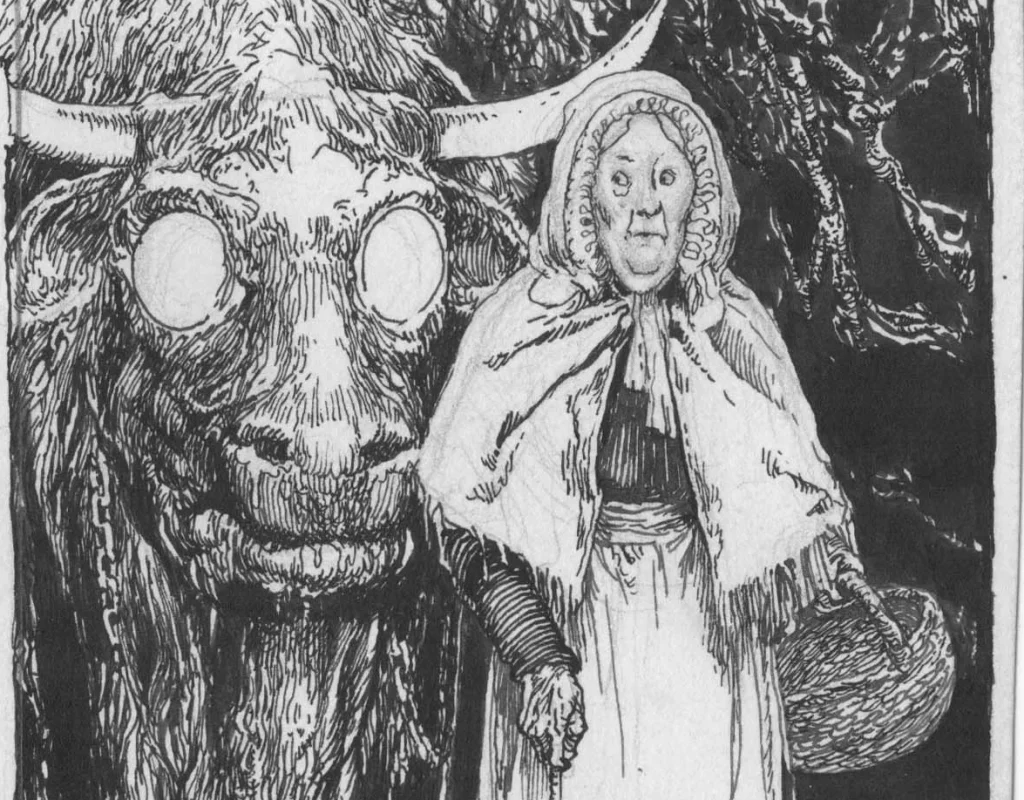
The creature also had a habit of appearing as a dairy cow.
This particular trick seems almost deliberately designed to annoy people.
A milkmaid would discover that a cow had escaped.
She would chase it.
The animal would keep just far enough ahead to remain out of reach.
The chase could continue for some time, with the animal apparently behaving like an ordinary stubborn cow.
Then, just when the milkmaid was about to catch it, the animal would disappear.
No gate had opened.
No field had swallowed it.
There was simply no cow anymore.
Instead, there would be that familiar strange laughter.
The story was particularly suited to rural communities where livestock were an important part of everyday life. A cow escaping wasn’t supernatural at all.
A cow that disappeared without explanation was another matter.
The Creature Could Steal a Human Voice
The animal disguises weren’t the only way the creature was said to fool people.
Some stories describe it imitating human voices.
It was supposedly known to appear around the windows of servant girls in manor houses, calling to them using the voices of their lovers.
Imagine hearing the voice of someone you know outside the window.
You look.
Nobody is there.
You hear it again.
You answer.
Still nothing.
The same trick could apparently be used with the voices of household masters, with strange calls coming from corridors or other parts of the building.
Voice imitation is a surprisingly common feature of older supernatural folklore. It works particularly well at night because people naturally rely on sound when they can’t clearly see what is around them.
And if the voice sounds exactly like somebody you trust, you’re much more likely to follow it.
That is precisely the sort of mistake this creature wanted people to make.
A Strange Connection With Births and Mourning
There was also an unusual belief that the creature behaved differently around births and deaths.
According to local tradition, it did not appear when people were experiencing serious grief or mourning.
Births were apparently different.
The creature was said to make appearances around the time a child was being born. It might frighten the horse of someone riding to fetch a midwife, knock on the door of the house, or create some other disturbance before disappearing.
Why?
Nobody seems to have known.
There is no clear explanation in the surviving stories for why the creature would apparently respect mourning but take an interest in births.
Perhaps it was simply another layer added to the local tradition over time.
It does, however, give the creature a slightly unusual personality. It wasn’t simply described as an evil supernatural being that appeared whenever it could.
There seemed to be rules to its behavior.
Even if nobody understood what those rules were.
The Pot of Gold
A later version of the story became popular as a children’s tale.
An old woman walking along a road discovers a pot filled with gold.
She looks around.
Nobody is there.
So she takes it home.
At some point during the journey, the gold changes into silver.
The woman isn’t particularly upset.
Silver is still worth something, after all.
She had initially considered taking the gold to the local constabulary because such a large amount of gold must surely have belonged to somebody else.
But now that it has become silver, she begins thinking differently.
Then the silver changes into iron.
Again, she decides that iron is better than nothing.
She reaches into the pot and pulls out the iron.
Only now it changes once more.
It becomes a stone.
But the stone moves.
The woman drops it.
The stone lands on the ground, wriggles, and begins dancing away.
Then she hears the laugh.
She finally understands who has been playing with her.
The Hedley Kow has tricked her again.
The interesting part is what happens next.
The woman doesn’t become furious.
Instead, she laughs to herself and considers herself lucky to have encountered the creature at all.
She had started with nothing.
She ended with nothing.
But she now had a story that nobody else could claim to have experienced.
Why Was It Always Playing Tricks?
This is probably the most unusual thing about the legend.
The creature doesn’t appear to have had a grand purpose.
It wasn’t hunting people.
It wasn’t collecting victims.
It wasn’t demanding sacrifices.
It wasn’t even particularly interested in causing physical harm.
It wanted to fool people.
That’s it.
The entire encounter could revolve around something incredibly stupid.
A stick.
A cow.
A voice.
Two people walking down a road.
A pot of supposed treasure.
The victim would fall for the trick, realize what had happened, and then hear the creature laughing.
That makes the creature a good example of a supernatural trickster in northern English folklore.
The fear comes from uncertainty rather than violence.
You don’t know what you’re looking at.
You don’t know whether the person ahead of you is really a person.
You don’t know whether the animal in the field is actually an animal.
And if you hear somebody calling your name from somewhere you can’t see, you can’t be completely certain that the voice belongs to them.
Durham and Northumberland Folklore
Stories like these fit naturally into the wider folklore of County Durham and Northumberland.
Northern England has a long tradition of stories about mysterious creatures, ghosts, strange lights, supernatural animals and unexplained encounters on isolated roads.
The landscape itself probably helped these stories survive.
Before modern roads and street lighting, a journey after dark could be genuinely difficult. Marshland could be dangerous. Rivers were obstacles. Farm animals wandered. Sounds travelled strangely across open countryside.
A person could easily encounter something they didn’t understand.
Then the story would be told.
And retold.
And eventually somebody would write it down.
By the nineteenth century, versions of the Kow story had appeared in print, preserving what had previously been passed from one storyteller to another.
That doesn’t necessarily mean every detail was centuries old. Folklore changes constantly.
One person remembers a cow.
Another remembers a horse.
Someone else remembers a strange person walking down the road.
But the central idea remains remarkably consistent:
Something ordinary isn’t what it appears to be.
A Different Kind of Folklore Creature
There is something refreshing about a creature that doesn’t need to murder anyone to become memorable.
Modern horror often assumes that a monster needs to be violent.
The Kow doesn’t.
Its victims survive.
Sometimes they are frightened.
Sometimes they’re embarrassed.
Sometimes they are simply left standing in the road wondering what on earth just happened.
That actually makes the stories feel like genuine pieces of local folklore rather than conventional monster stories.
The creature isn’t there to end the story.
It is there to make the story happen.
Someone follows the wrong person.
Someone picks up the wrong stick.
Someone chases the wrong cow.
Someone hears the wrong voice.
And somewhere nearby, something is laughing.
The Hedley Kow may never have been the most terrifying creature in British folklore, but it didn’t need to be. Its strange combination of shape-shifting, voice imitation, disappearing animals and harmless deception made it one of those local legends that could be passed from one generation to the next.
Perhaps that’s the real reason the story survived.
A terrifying monster gives people a nightmare.
A creature that makes you look ridiculous gives people something to talk about for years.