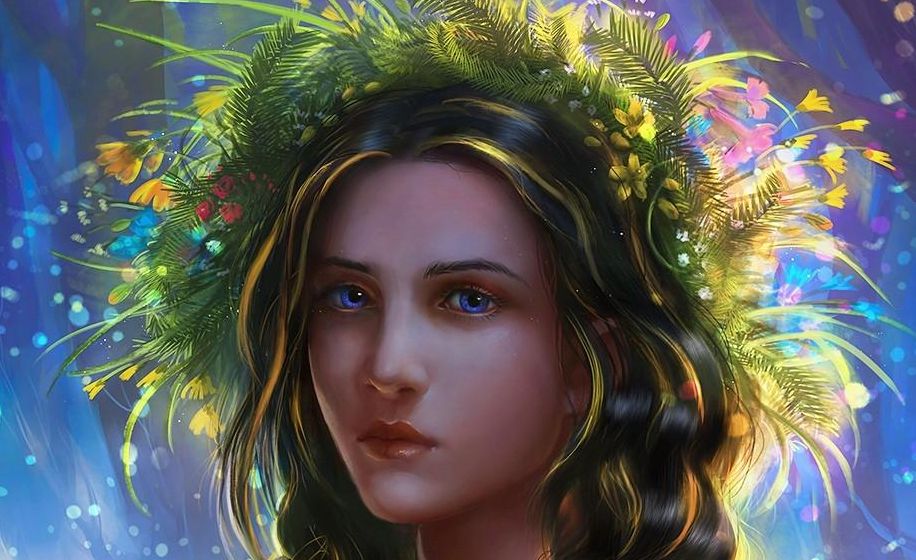
Mavka mythology is one of those subjects I stumbled across while looking into Slavic folklore, and honestly, the more I read about it, the stranger it got. At first, mavkas sound like the sort of creatures you’d expect to find in a fairy tale. Beautiful young women wandering through forests, dancing in flower-filled clearings, maybe singing somewhere near a river. Nothing particularly frightening about that, right? Well, not exactly. In Ukrainian folklore, mavkas can be much darker than their appearance suggests. They’re associated with the wilderness, the dead, and stories about people who encounter something beautiful in the woods only to discover that it isn’t quite what it seems.
What I find interesting is that a mavka doesn’t always need to look frightening. In fact, that’s pretty much the point. You might see one and assume she’s an ordinary woman who has somehow ended up alone in the forest. There’s no obvious monster, no terrible face appearing out of the darkness. Just someone standing between the trees, looking perfectly comfortable in a place where most people wouldn’t want to spend the night.
And then there are the stories about what happens when you follow one.
So, What Is a Mavka?
Mavkas are female supernatural beings found in Ukrainian folklore. They’re often associated with forests, meadows, springs, and other natural places, although descriptions vary depending on the region and the particular story.
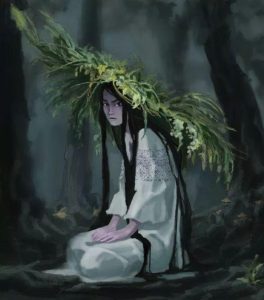
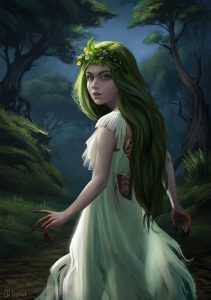
They’re usually described as beautiful young women with long hair, sometimes decorated with flowers. They might appear in light clothing, dance in groups, or wander through the woods as if they’re completely unaware of the human world around them.
Some accounts connect mavkas with the souls of people who died young, including children who died without baptism or young women who died before their time. Other traditions describe them more generally as supernatural spirits associated with the dead and the natural world.
There isn’t one single explanation that covers every version of the legend, which is something worth remembering when reading about Slavic folklore. Stories changed as people passed them between villages, and different communities didn’t necessarily believe exactly the same things.
Still, there’s a recurring idea behind many descriptions of mavkas: they look alive, but something about them connects them to death.
That alone gives the creature a rather uncomfortable place in folklore. She’s not quite a ghost in the familiar sense, but she’s not an ordinary woodland fairy either. Depending on the story, she might be playful, dangerous, tragic, or some combination of all three.
I think that’s much more interesting than simply making her another evil creature that exists to scare people.
The Detail About Their Backs Is Genuinely Creepy
One of the strangest details associated with mavkas is the claim that they have no proper back. In some traditional descriptions, their backs are hollow or open, exposing their internal organs.
It’s a pretty disturbing image when you stop and think about it.
Imagine meeting a young woman in the woods. She looks normal from the front, perhaps even unusually beautiful. You might talk to her without feeling the slightest bit afraid. Then she turns around, and suddenly you realize that her body isn’t quite human.
That detail doesn’t appear in every account, and plenty of modern illustrations leave it out. But it’s one of the features that makes traditional descriptions of mavkas so memorable.
There’s something about the contrast that works particularly well. A creature with horns, claws, or a monstrous face gives you an immediate warning. You know you’re looking at something dangerous. A mavka can be the opposite. Her appearance might encourage you to trust her, and the horror comes from discovering that your first impression was wrong.
It also fits with the idea that these beings occupy a strange position between life and death. They can resemble living women while lacking something fundamental that a living human should possess.
Of course, if you actually encountered something like this in a forest, you’d probably have more immediate concerns than its place in Ukrainian mythology.
But as a piece of folklore, it’s a memorable detail, and it helps explain why mavkas can be so unsettling despite their beautiful appearance.
Why Would Anyone Follow One Into the Forest?
This is where the stories get interesting.
Mavkas are often associated with dancing, singing, and luring people away from familiar paths. In some accounts, they can lead travelers deeper into the woods, where they become lost or suffer a terrible fate.
Not every version of the legend describes the same behavior, but the general idea of a supernatural woman drawing someone away from safety appears in different forms of folklore.
And, really, the forest is the perfect place for that kind of story.
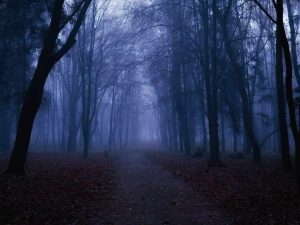
Think about walking through a wooded area just before sunset. You know the route, you’ve walked it before, and everything seems ordinary. Then you hear something that sounds like laughter somewhere among the trees.
You stop for a moment.
Maybe it’s people from a nearby village. Maybe someone is having a picnic, or there’s a house hidden beyond the trees that you didn’t know about. You can’t quite tell where the sound is coming from, but it doesn’t seem particularly far away.
So you leave the path to have a look.
A few minutes later, the laughter is still there, but you haven’t found anyone. The trees are thicker now, and the path you were following has disappeared behind you. You start to wonder whether you’ve walked farther than you intended.
That’s the kind of situation in which a mavka legend makes sense as a story. The forest doesn’t have to contain anything supernatural for the experience to become frightening. You only need to be unsure of where you are and what you’re hearing.
Traditional beliefs gave that uncertainty a face.
Instead of blaming poor visibility, unfamiliar terrain, or the tricks that sound can play among trees, a story might describe a spirit that deliberately leads people astray.
I’m not suggesting that all mavka stories originated from people getting lost in the woods. Folklore has complicated origins, and we can’t reduce an entire tradition to one explanation. But the connection between dangerous woodland spirits and the real risks of traveling alone is hard to ignore.
Mavkas Aren’t Always Evil
One thing I don’t particularly like about modern descriptions of folklore creatures is how quickly they get labelled as good or evil.
A mavka can certainly be dangerous in traditional stories, but that doesn’t mean every account presents her as a malicious monster.
Some descriptions emphasize her connection with nature. Others focus on the circumstances that supposedly created her, particularly stories involving untimely death. In those versions, the creature can feel less like a villain and more like a tragic figure who never entirely escaped the world of the dead.
That changes the way you look at the legend.
If a mavka is connected to someone who died young, there’s an obvious sadness behind the story. The creature’s existence becomes tied to a life that ended before it should have. Her beauty and her connection with spring might suggest youth and vitality, while her supernatural nature reminds us that something has gone wrong.
Of course, that doesn’t mean she’s harmless. A tragic figure can still be dangerous, and folklore has never required its supernatural beings to behave according to ordinary human morality.
Perhaps a mavka doesn’t think of herself as hunting people. Perhaps she simply belongs to a world where the rules are different, and humans who wander into it don’t understand the consequences.
That’s a much more interesting possibility than assuming every strange creature wants to kill someone.
It also leaves room for different storytellers to interpret her in their own ways. One might describe a terrifying encounter with a spirit that leads a man to his death. Another might tell a sadder story about a beautiful figure wandering alone through the woods, unable to return to the life she once had.
Both versions can be unsettling for different reasons.
The Connection Between Mavkas and Spring
Despite their darker associations, mavkas are often connected with the beauty and energy of nature.
They appear in descriptions of green forests, flowering meadows, and places where plants grow freely. Their long hair may be decorated with flowers, and dancing is a recurring image in many portrayals of these spirits.
Spring seems particularly fitting for them.
After a long winter, the landscape changes almost overnight. Trees develop fresh leaves, flowers appear, and the woods become full of birdsong. Places that looked lifeless a few weeks earlier suddenly feel crowded with activity.
It’s easy to understand why people living close to the natural world might imagine spirits inhabiting these places.
But there’s a strange contrast here. Spring is usually associated with new life, while mavkas are also linked to death and restless souls. They’re beautiful and full of movement, yet some traditions describe them as beings who have been separated from ordinary human life.
That combination gives the legend a melancholy quality.
A mavka dancing among flowers doesn’t necessarily have to be a frightening sight. In a different kind of story, she might represent the freedom of the wilderness, untouched by the expectations of human society.
But there’s still something unsettling about imagining her dancing alone in a place where nobody should be.
Especially if you notice that the other figures dancing with her aren’t leaving any footprints.
That last detail is more of a modern horror image than a universal feature of traditional mavka stories, but it captures the kind of atmosphere the folklore inspires.
Mavkas and Rusalkas: Are They the Same Thing?
If you’ve spent any time reading about Slavic folklore, you’ve probably come across rusalkas as well. They’re another type of supernatural female figure, often associated with water, rivers, lakes, and the souls of the dead.
Because there are similarities between the two, mavkas and rusalkas are sometimes treated as interchangeable creatures in modern discussions.
That’s a little misleading.
Mavkas are particularly associated with Ukrainian traditions and woodland settings, while rusalkas are often connected with bodies of water in various Slavic traditions. Both can be described as beautiful female beings, and both may be dangerous to humans.
However, the boundaries aren’t always clear. Regional beliefs overlap, names change, and stories develop in different directions over time.
It’s also worth remembering that Slavic folklore isn’t one enormous collection of identical beliefs shared by every Slavic-speaking community. Ukrainian, Belarusian, Russian, and other regional traditions have their own histories and variations, even when they contain related supernatural figures.
So if one article describes a mavka as a forest spirit and another compares her to a water spirit, that doesn’t necessarily mean one author has invented the entire idea. They might be discussing different traditions, or they might be simplifying distinctions that are more complicated than they appear.
Personally, I find the woodland association particularly effective. Water has its own dangers and mysteries, but there’s something about a dense forest that makes it easy to imagine a person disappearing without leaving any obvious explanation.
A river can carry someone away. A forest can make you wonder whether they were ever there at all.
How Did People Protect Themselves?
Like many supernatural figures in traditional folklore, mavkas belong to a world in which certain places and encounters were thought to carry risks beyond ordinary explanations.
Protective customs varied between communities. Slavic folk traditions included prayers, religious gestures, ritual practices, and objects believed to protect people from supernatural harm. However, it’s important not to assume that every protective practice was specifically intended to repel mavkas.
The beliefs weren’t identical everywhere, and different spirits could have different customs associated with them.
There was also a practical side to avoiding dangerous encounters in the wilderness. Staying on familiar paths, traveling with others, and avoiding isolated places after dark were sensible precautions regardless of whether somebody believed in forest spirits.
The two ideas could easily coexist.
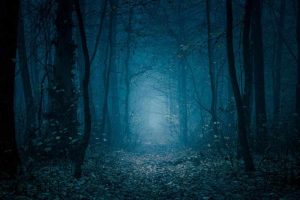
If a person had grown up hearing stories about supernatural women who lured travelers into the woods, they might have been more reluctant to wander away from a path at night. The story could reinforce a warning that already made sense in everyday life.
And that’s one of the reasons folklore can be so difficult to separate from ordinary experience. A frightening story doesn’t have to be literally true to influence behavior.
Even now, people sometimes feel uneasy in places associated with local legends. They might laugh about the stories during the day, then remember them when walking through the same place after dark.
Whether or not they believe in the supernatural is almost beside the point. The story has already changed how they experience the place.
The Mavka in Literature and Modern Culture
Mavkas have survived well beyond traditional storytelling, and their modern portrayals can be quite different from the darker versions found in folklore.
One important example is The Forest Song, a dramatic poem by Ukrainian writer Lesya Ukrainka, published in 1911. The work draws on Ukrainian folk traditions and features Mavka, a woodland being whose relationship with the human world becomes central to the story.
Rather than presenting her simply as a monster, the work explores themes of love, nature, freedom, and the conflict between the natural world and human society.
More recently, Mavka: The Forest Song introduced a fantasy interpretation of the character to a wider international audience through animation. Its colorful world and emotional storyline emphasize magic and the beauty of nature rather than the more disturbing aspects associated with some traditional descriptions.
I think this is a good example of how folklore changes over time.
A character who might once have been associated with dangerous encounters in the woods can become a sympathetic heroine in a modern story. Artists can preserve certain features while changing others to suit a different audience.
That doesn’t necessarily make the newer version wrong. It simply means that we’re looking at an adaptation rather than a direct representation of every traditional belief.
Still, anyone discovering mavkas through modern fantasy might be surprised to learn that the folklore behind the character can be considerably darker.
The contrast between those interpretations is part of what makes the subject worth exploring. The same figure can represent freedom and natural beauty in one work, then become a disturbing reminder of death and the unknown in another.
Why I Think Mavkas Make Such Effective Horror Figures
For me, the most interesting thing about mavkas isn’t any single supernatural ability. It’s the uncertainty surrounding them.
A creature that immediately looks monstrous tells you what you’re dealing with. A beautiful woman standing in a forest doesn’t.
You might see her and assume she’s lost. You might hear her singing and think there’s a village nearby. Perhaps she asks you a question, smiles at you, and then walks between the trees.
Nothing obviously terrible has happened.
But there’s still that uncomfortable feeling that you should probably leave.
That’s what makes this kind of folklore work so well. The danger begins with something ordinary, and the person encountering it has to decide whether there’s any reason to be afraid.
There is also the question of what the mavka represents. In some traditions, she’s connected to the dead. In others, she’s part of a supernatural natural world that humans cannot fully understand. Those ideas aren’t necessarily contradictory, but they create a character who is difficult to explain completely.
And I like that the stories don’t always need to settle the question.
Sometimes the most effective ending is simply that somebody went into the forest and never returned, leaving the villagers to argue about what happened.
Was there really a mavka? Did the traveler get lost? Did somebody hear singing and mistake its source? Or was there something in the woods that didn’t want to be found?
Folklore leaves room for all of those possibilities.
The Strange Appeal of Ukrainian Mavka Mythology
Mavkas are much more than beautiful women wandering through flower-filled forests. They’re part of a tradition in which the natural world can be mysterious, dangerous, and closely connected with the dead.
Their appearance varies between accounts, as does their behavior. Some stories emphasize their beauty and connection with nature, while others focus on their ability to lure travelers away from safety. Certain traditions associate them with tragic deaths, giving the creature a more sorrowful side.
That mixture is what makes them memorable.
They’re not quite ghosts, not quite fairies, and not entirely comparable to the other female spirits found throughout Slavic folklore. They occupy a space between those categories, which makes it difficult to define them without losing something important about the stories.
And perhaps that’s the point.
Folklore doesn’t always exist to give us a neat explanation of the world. Sometimes it reflects the things people fear, the places they don’t fully understand, and the strange possibilities that come to mind when they’re alone somewhere unfamiliar.
The next time you see a picture of a beautiful woman standing in a sunlit forest, it might be tempting to think of a mavka as a harmless fantasy character.
But remember that the modern image is only one interpretation.
In the darker stories, the woman among the trees might not be lost at all. She might belong there, and the person watching her might be the one who has wandered into the wrong place.
And if she starts singing as you approach, well, I’d probably keep walking.