Something small moved between the trees. It was there for only a moment, low against the dark undergrowth, and then it seemed to disappear completely. Stories like this have long surrounded the Pukwudgie, a strange little being associated with the Wampanoag people of southeastern New England. It is difficult to say where the old stories end and modern sightings begin, particularly in the wooded landscapes of Massachusetts where the creature has become part of a much larger tradition of unexplained things.
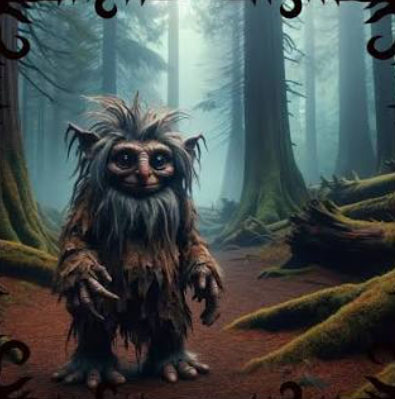
The Pukwudgie is usually described as a small, human-like being, sometimes only two or three feet tall. Older descriptions and later retellings give it gray skin, prominent ears, a large nose, and an appearance that can seem almost human until something feels slightly wrong. Some accounts compare its back to that of a porcupine, while others give it a more ordinary woodland appearance. The details shift from one telling to another, which is common with folklore that has been carried orally for generations.
What remains more consistent is its temperament.
The pukwudgie creature is not simply a monster hiding in the forest. In Wampanoag tradition, these beings were once said to have lived alongside people and could even be helpful when treated properly. Over time, however, the relationship deteriorated. The Pukwudgies became associated with mischief, deception, and eventually genuine danger. They were said to disappear suddenly, change their appearance, create fire, and use magical weapons such as poisoned arrows.
There is something particularly interesting about this transformation. The pukwudgie creature does not fit neatly into the familiar idea of an evil supernatural monster. It is closer to the older tradition of the unpredictable woodland being, a creature that does not necessarily hate humanity but has little reason to care about human rules.
Perhaps that is why the stories feel so uneasy.
The name itself has been translated in different ways, including a phrase roughly meaning “little wild man of the woods who vanishes.” Such a description is almost more unsettling than a dramatic name would be. A giant can be seen from a distance. A dangerous animal leaves tracks. A little wild being that can simply vanish is another matter entirely.
Wampanoag stories also connect the Pukwudgies with Maushop, a giant culture hero who appears in traditional stories of the region. According to one well-known version, the Pukwudgies became jealous of the affection given to Maushop and eventually turned against him and his family. Maushop then drove them away, scattering them from the lands where they had once lived. The details vary considerably between versions, but the basic idea remains: something that once lived near people became something that people learned to fear.
It is worth remembering that these stories belong to a living Native tradition, rather than treating them simply as an old collection of monster tales. The Wampanoag homeland includes parts of present-day Massachusetts and Rhode Island, and the landscape itself plays an important role in the stories. Swamps, forests, cliffs, rivers, and isolated stretches of woodland were not merely scenery. They were places with their own histories and meanings.
One of the most famous landscapes connected with modern Pukwudgie stories is Hockomock Swamp in southeastern Massachusetts. The swamp later became part of the area known as the Bridgewater Triangle, a roughly 200-square-mile region associated with reports of strange lights, unidentified creatures, ghosts, and other unexplained events. The name Bridgewater Triangle itself is modern, having been coined by cryptozoologist Loren Coleman in the 1970s.
This is where the modern pukwudgie cryptid begins to take on a life of its own.
The word “cryptid” belongs to modern cryptozoology, not to the original Wampanoag tradition. It describes an animal or creature whose existence is claimed but has not been scientifically established. Calling the Pukwudgie a pukwudgie cryptid therefore places an older piece of folklore into a much newer framework. The distinction matters. The traditional Pukwudgie is a figure within a cultural and spiritual story system, while the modern cryptid is often presented as something that might physically exist somewhere in the woods.
Those two ideas have gradually become mixed together.
That mixture is especially visible around Freetown State Forest, where modern accounts have attached the Pukwudgie to reports of strange encounters. Loren Coleman has written about the creature in connection with the Bridgewater Triangle, noting descriptions of small gray-skinned beings with unusual features and magical abilities.
Of course, none of this establishes that a physical Pukwudgie creature is living among the Massachusetts trees. There is no accepted zoological evidence for such a being. What is real, however, is the persistence of the story and the way the landscape continues to give it somewhere to live in the imagination.
That may explain why the Pukwudgie remains more interesting than many modern cryptids. It did not begin as a blurry photograph or a late-night roadside encounter. Its roots reach much further back, into stories about people, spirits, giants, wilderness, and the uneasy boundary between human settlements and the world beyond them.
Folklorists have long noted that supernatural beings often occupy precisely these uncertain spaces. They appear at the edge of the village, beyond the familiar path, beside the water, or somewhere in the trees where visibility becomes unreliable. The Pukwudgie belongs comfortably in that tradition.
Perhaps the most memorable part of the legend is therefore not its weapons, its strange appearance, or even its ability to vanish.
It is the simple possibility that something small may be standing just beyond the path, watching quietly, waiting for the moment when the trees become too dense to see through.
And if the old stories are right, that may be exactly where the pukwudgie cryptid has always preferred to remain.