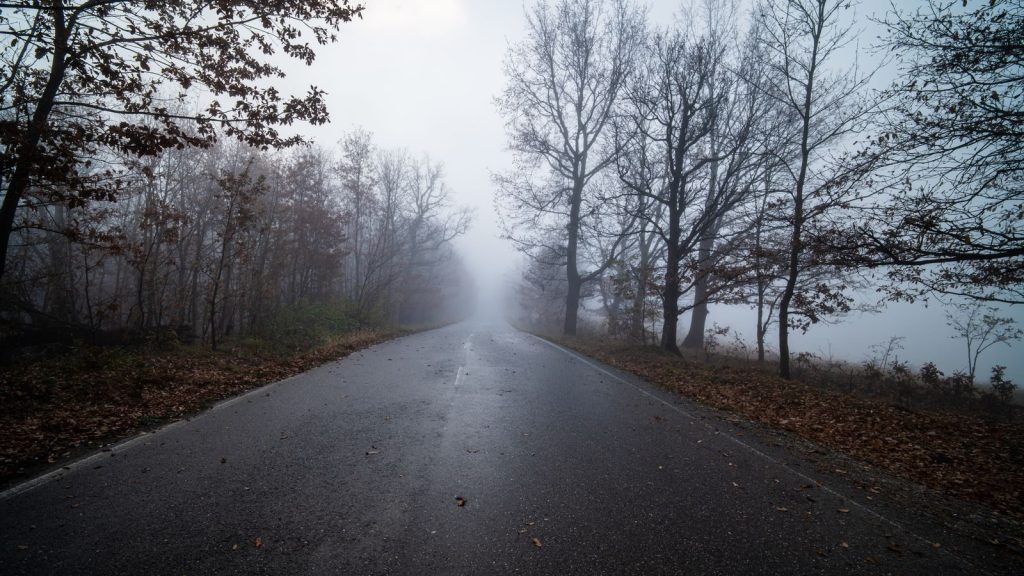
The Crawfordsville Monster appeared in the darkness of an Indiana road. In the summer of 1973, something large and strangely shaped was reportedly seen near Crawfordsville, a small city west of Indianapolis, where the ordinary landscape of cornfields, wooded roads, and quiet farmhouses briefly became the setting for something that seemed to belong somewhere else.
The story emerged during a period when American newspapers and local communities were still fascinated by reports of mysterious creatures. Bigfoot had become a national obsession, UFO sightings filled magazines, and older traditions concerning wild men and unknown animals were being reshaped into the language of modern cryptozoology. Against this backdrop, the Crawfordsville Monster became one of Indiana’s more obscure creature stories, remembered less for a definitive encounter than for the peculiar details attached to it.
The creature was described as a large, hairy figure, although accounts have varied considerably over time. Some versions portray it as resembling the familiar North American wild man, while others emphasize an unusual appearance that made it difficult to classify as either an animal or a person. The uncertainty is important. A monster that can be comfortably identified becomes a zoological problem. One that cannot be identified becomes folklore.
Crawfordsville itself is an unlikely place for such a story, which is perhaps precisely why the legend has endured. Founded in the nineteenth century and surrounded by the agricultural landscape of west-central Indiana, the city lies far from the mountainous wilderness normally associated with American wild-man traditions. Yet forests do not need to be immense to feel mysterious at night. A narrow road, a patch of trees, and an unfamiliar silhouette can transform a familiar landscape into something considerably less certain.
The Crawfordsville Monster belongs to a much older tradition than its name suggests. Across Europe, Asia, and North America, cultures have preserved stories of beings that occupy an uncertain boundary between humanity and the wilderness. Medieval European traditions spoke of wild men living beyond settled society. Indigenous traditions across North America contain numerous accounts of powerful beings associated with forests, mountains, and remote places, although these traditions are culturally distinct and should not simply be treated as early versions of Bigfoot.
By the twentieth century, however, many such stories had been gathered under a modern category: the hairy wild man. The American Bigfoot tradition became especially influential after the famous 1958 newspaper reports from northern California, when the name “Bigfoot” entered popular culture. Reports from other states were subsequently interpreted through the same framework, even when their original traditions had little connection to one another.
This is where the Crawfordsville Monster becomes particularly interesting. It was not part of a vast, continuous mythology with an established name, sacred history, or traditional rituals. Instead, it belonged to the modern folklore of the unexplained encounter. Someone sees something in poor light. The figure disappears. Details are discussed afterward, repeated by witnesses or newspapers, and gradually become inseparable from the story itself.
Folklorists have long noted that such stories often become stronger through repetition rather than through additional evidence. Each retelling selects certain details, discards others, and gives the surviving elements a greater sense of permanence. A creature that was originally described only as strange may eventually acquire a height, a gait, a color, or a particular manner of appearing in the darkness.
There is also something distinctly American about this process. The wilderness in the United States has frequently served as a psychological border, even when actual wilderness has been reduced by roads, farms, towns, and industry. The idea that something ancient might still inhabit the remaining woods offers a peculiar contradiction: modern civilization may have mapped almost everything, yet there could still be something standing just beyond the edge of the headlights.
The Crawfordsville Monster therefore does not need to be accepted as an undiscovered species to be culturally significant. Its importance lies partly in the uncertainty surrounding it. Was an ordinary animal misidentified? Was an unfamiliar person seen under strange conditions? Did several unrelated observations become connected through storytelling? Or did the witnesses encounter something that genuinely resisted explanation?
Of course, none of these possibilities can be established simply through the legend. There is no universally accepted physical evidence that transforms the Crawfordsville Monster from folklore into zoology. What remains is the story itself, preserved because it occupies that uncomfortable territory where certainty becomes difficult.
Perhaps that is why the Crawfordsville Monster continues to have a quiet appeal. The most enduring monster stories rarely depend upon proving that a creature exists. They depend upon preserving the possibility that, for a few seconds, the world was not quite as familiar as it had seemed.
Long after the witnesses had gone home, the roads around Crawfordsville remained ordinary roads, bordered by ordinary fields and trees. Yet somewhere in the accumulated memory of the place, there remains the image of a large figure disappearing into the darkness, leaving behind no specimen, no final explanation, and just enough uncertainty to suggest that the night may contain more than the light reveals.