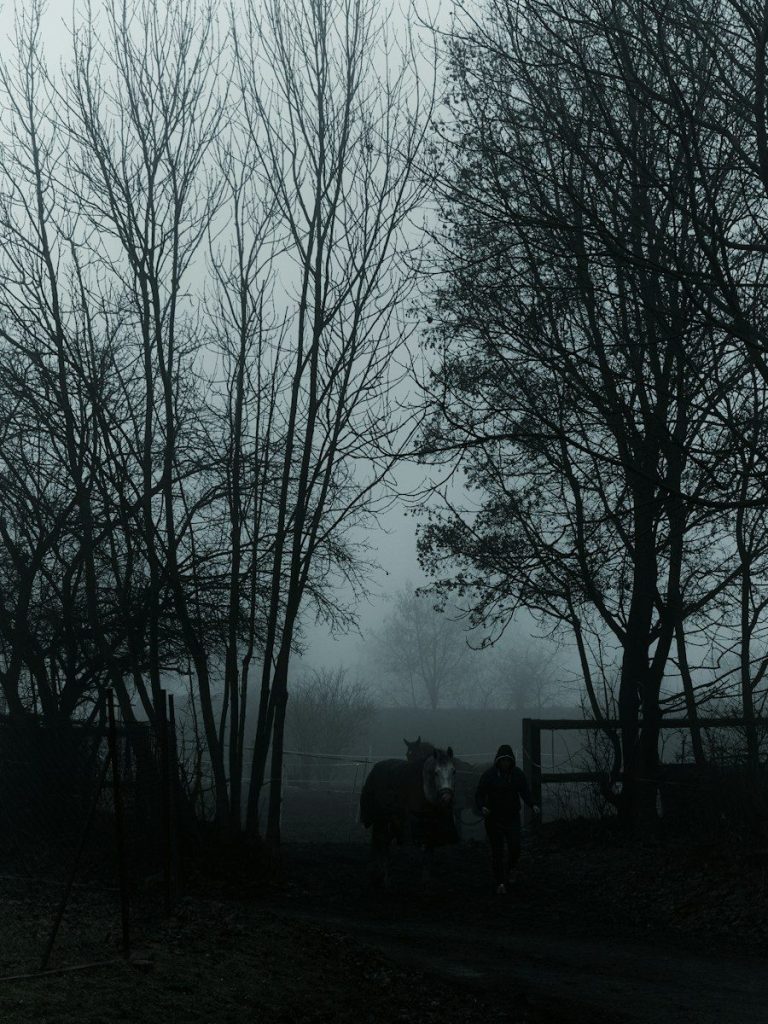
You hear the horse before you see it.
Hooves on the road.
Slow at first. Then closer.
You look down the empty lane, expecting to see someone riding toward you. Maybe a farmer coming home late. Maybe a traveler who took the wrong road.
Instead, you see a black horse.
And on its back is a man with no head.
That is the part people usually remember about the Dullahan.
But the strange thing about the Dullahan is that the headless rider is almost the easy part.
The older stories give him a much darker role.
The Dullahan is one of the most frightening figures in Irish folklore, and unlike many creatures that simply attack people, he is usually connected with something much worse.
Death.
If the Dullahan comes looking for you, there may be no running from him.
The Dullahan appears in Irish folklore as a headless rider, usually traveling through the countryside on a black horse. In some versions, he carries his own head under one arm. The head is not just a dead, useless thing, either. It can see across great distances and recognize people even in the dark.
That detail makes the story much more unsettling.
Imagine standing inside your house at night.
You hear a horse outside.
You look through the window.
Nothing.
Then you hear the horse again, but this time it sounds like it is right beside the house.
You look again.
The rider is staring directly at you.
Except he has no head.
Some versions of the the dullahan story give him a whip made from a human spine. Others describe him carrying a strange object that allows him to see distant places. There are also stories in which the Dullahan rides a black carriage pulled by several horses.
The details change from one telling to another.
The warning does not.
The Dullahan is associated with death.
That is what separates the dullahan myth from a simple monster story.
He is not necessarily hunting people because he wants to hurt them. Instead, his appearance can be a sign that someone is about to die. In some traditions, he stops outside a person’s home and calls their name.
Once the name is called, the person’s death is near.
There is something especially disturbing about that idea.
You don’t have to fight him.
You don’t have to escape from him.
You just have to hear your name.
The origins of Irish myths are difficult to pin down because these stories were passed down orally for generations before many of them were written down. That means there was never one official version of the Dullahan. Local storytellers could change details, add new ones, or connect the figure with older beliefs about death and the supernatural.
This is also why the Dullahan fits so naturally among Irish folklore creatures.
Irish folklore is full of beings that live close to the boundary between ordinary life and death. Some are dangerous. Some are mysterious. Some are not clearly good or evil at all.
The Dullahan is different.
He feels like a warning.
There is an old belief that the Dullahan cannot be stopped once he has begun his journey. Roads, gates, and locked doors are not much use. In some accounts, simply seeing him is enough to bring terrible consequences.
And then there is the gold.
According to one popular tradition, the Dullahan is afraid of gold. A small piece of gold could supposedly make him disappear or force him to leave.
It sounds almost ridiculous.
A headless supernatural rider that fears gold.
But folklore often works like that. A terrifying creature is given one strange weakness, perhaps because people needed to believe that even something connected with death could be kept away.
There is another detail that makes the Dullahan particularly memorable.
He does not need darkness.
Some stories place him on lonely roads at night, but others describe him appearing at different times and places, riding through villages or across the countryside without warning.
And when he arrives, the sound comes first.
The horse.
The wheels.
The movement on the road.
Then the rider.
That may be why the story has survived so well.
You can remove the castles, the ancient battles, and the old names from Irish folklore. You can put the story on a modern road and it still works.
A person driving home late sees a figure beside the road.
A black horse.
A rider.
No head.
The car passes.
The driver looks in the mirror.
Nothing.
Then, somewhere behind them, they hear the sound of hooves again.
That is the real strength of the the dullahan headless horseman legend. It does not need a complicated explanation. The image is enough.
A rider carrying his own head.
A road with nobody else on it.
And the possibility that he isn’t there to scare you at all.
Maybe he is there because he already knows something you don’t.
Your name.
And when the Dullahan finally calls it, the road may be the last thing you ever hear beneath your feet.