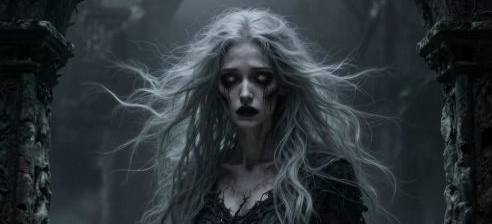
Some stories about mythical creatures begin with a strange shape seen between the trees. Others begin with a voice. Someone hears their name called from a field after dark, recognizes a familiar voice somewhere beyond the house, or hears a child crying in a place where no child should be. The idea behind mythical creatures that mimic human voices is simple enough: something in the darkness sounds like a person you know, and you have to decide whether to answer.
What’s interesting is that this isn’t one single monster with a standard set of abilities. Different traditions have developed different versions of the idea. In some, a creature copies a human voice to lure someone away from safety. In others, a supernatural woman cries out because a death is approaching. Some stories involve an animal believed to imitate people, while others have acquired their voice-mimicking abilities through modern horror fiction.
Those distinctions matter. The Irish banshee, for instance, is not simply a forest predator with a clever trick. And although modern stories often give the wendigo an uncanny ability to imitate its victims’ loved ones, that feature shouldn’t automatically be treated as a universal part of Indigenous traditions about the being.
There are older stories about deceptive voices, though, and one of the more striking examples comes from the ancient Mediterranean world.
1. The Hyena That Learned Your Name

One of the oldest written accounts of an animal imitating human speech appears in the work of the Greek writer Aelian, who lived around the second and third centuries AD. In On the Characteristics of Animals, he describes a hyena hiding near woodcutters, listening to them call to one another, and then reproducing their voices.
The trick is unpleasantly straightforward. The hyena calls a man by name, withdraws when he approaches, and calls again from farther away. The man follows, eventually separating himself from his companions. Once isolated, he becomes the animal’s prey.
The account is discussed in a modern scholarly article published by the Center for Hellenic Studies at Harvard University. It connects the episode to a wider folktale pattern in which a predator imitates the voice of a guardian to deceive vulnerable listeners.
Aelian even includes a detail that feels surprisingly modern: the animal supposedly imitates the voice of the person its intended victim is most likely to obey. In other words, it doesn’t merely make a human noise. It exploits recognition and trust.
There is an important qualification here. Aelian’s book contains ancient beliefs about animals alongside observations about the natural world, and the author himself acknowledges that the hyena story may be fabulous. It isn’t reliable evidence that hyenas can reproduce human speech.
Real spotted hyenas have a varied vocal repertoire, including whoops, giggles, and calls that can sound startlingly strange to people unfamiliar with them. That doesn’t make the ancient story true, but it does help explain why an animal associated with scavenging, night activity, and eerie sounds could become the subject of unsettling tales.
What makes Aelian’s version particularly useful is its age. The familiar modern horror setup—a voice calls from somewhere out of sight, the listener recognizes it, and following it becomes dangerous—was already present in ancient animal lore. We don’t need to assume that every later legend descended from this particular story. The resemblance is enough to show that the basic fear is old.
2. The Nishi Daak: A Familiar Voice After Dark
In Bengali folklore, the Nishi Daak is associated with a call heard at night. The name is commonly translated as something like “call of the night,” and the central idea is more disturbing than the name might suggest: an unseen presence calls to someone in a familiar voice, encouraging them to leave home.
The caller might sound like a relative or someone the listener knows. The danger lies in the listener’s response. Rather than confronting a visible monster, the person is drawn outside by what appears to be an ordinary human voice.
Modern accounts of the Nishi Daak often include a rule that the entity calls a person’s name twice and that the person should never answer. This detail appears in contemporary retellings, including modern folklore websites, but it should not be treated as a universally documented rule across every Bengali community or as an established feature of an ancient, unchanging tradition.
The distinction matters because stories circulating online often present regional folklore as if it came with an official instruction manual. A memorable rule can spread rapidly, even when its precise historical origin is unclear.
The Nishi Daak belongs to a different category from the hyena in Aelian’s account. Aelian describes an animal using a deceptive call to separate a person from a group. In the Nishi Daak stories, the caller’s apparent familiarity is central to the danger. The voice makes the invitation seem safe before the listener has any reason to suspect otherwise.
For readers interested in folklore, the question of what happens after someone answers is only part of the story. The belief also concerns the boundary between a protected domestic space and the darkness outside it. A voice that would ordinarily be a reason to open the door becomes a reason to leave it shut.
There is no verified evidence that a supernatural caller exists. The Nishi Daak is best discussed as a regional folkloric belief whose details need to be traced through actual collected accounts rather than repeated uncritically from modern summaries. Its place in this article is the particular kind of deception it represents: the voice is recognizable, but recognition alone cannot establish who—or what—is calling.
3. The Banshee: A Voice That Announces Death
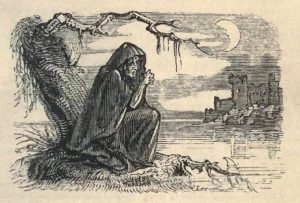
The name comes from the Irish bean sí, commonly translated as “fairy woman.” In traditional accounts, the banshee may be heard wailing near a house or associated with a particular family. Her appearance varies: some stories describe a young woman, others an old woman, and some accounts focus almost entirely on the sound.
The Smithsonian Center for Folklife and Cultural Heritage discusses the variety of banshee traditions and the work of Irish storyteller Eddie Lenihan, who has spent decades collecting and sharing oral stories. The article emphasizes that the banshee’s cry can be described in different ways, from a lonely wail to a rising and falling lament.
That variation is worth noticing. The banshee isn’t simply a monster with one signature scream. Her voice belongs to a tradition of mourning.
Irish caoineadh, or keening, was a form of lament associated with wakes and funerals. Women’s voices played a prominent role in this practice, and the sound could involve crying, singing, and improvised praise for the deceased. The banshee’s supernatural lament has a recognizable relationship to this cultural setting, although it would be too simple to claim that the entire tradition originated from one mourning custom.
A particularly well-known literary account is “The Bunworth Banshee,” collected by Thomas Crofton Croker in his Fairy Legends and Traditions of the South of Ireland. The story concerns Reverend Charles Bunworth, a real historical figure whose death became connected with reports of a supernatural woman and her lament.
Croker’s collection appeared in the nineteenth century, decades after Bunworth’s death. That gap is important: the book is evidence that the story was being recorded and circulated, not independent proof that the reported supernatural events happened. The source history also leaves room for family and local storytelling to have shaped the account.
So why include the banshee in an article about creatures that mimic human voices? Because she illustrates a related but distinct idea: a human-sounding voice can carry information that ordinary speech cannot. Her cry is interpreted as a warning or announcement, rather than an attempt to trick someone into following it.
The difference between those two roles is easy to lose in modern monster lists. A banshee that wails before a death and a creature that imitates your sister calling from the woods may both inspire fear, but they do not do the same thing in their respective traditions.
4. The Wendigo and the Problem With Modern Voice-Mimicking Monsters
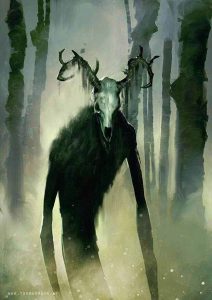
Search for creatures that imitate human voices and the wendigo will probably appear fairly quickly. Online horror stories describe a creature calling from the woods in the voice of a missing hiker, a family member, or someone asking for help. Sometimes the voice is almost convincing. Sometimes something about it is slightly wrong.
These stories fit the modern wilderness-horror genre very well. The difficulty is establishing how much of this portrayal belongs to older traditions about the wendigo.
The wendigo is associated with Algonquian-speaking peoples, including Anishinaabe traditions, and its meanings are more complex than the familiar image of a skeletal monster wandering through snowy forests. Traditional accounts can concern cannibalism, insatiable hunger, spiritual danger, and the violation of social obligations. The details differ between communities and sources.
The modern version has absorbed numerous horror conventions. Antlers, exaggerated skeletal anatomy, enormous size, and elaborate predatory abilities are common in contemporary depictions, but they should not be assumed to represent every traditional account.
The same caution applies to voice mimicry. A modern cryptid article may describe the wendigo perfectly imitating a loved one’s voice, but that does not establish the feature as a defining characteristic across historical Indigenous traditions. The association between the wendigo and vocal imitation is particularly prominent in contemporary horror material, including games and internet storytelling.
This is one of those cases where a little source-checking changes the article. It would be easy to repeat the usual description of a wendigo calling a hunter’s name through a snowstorm. It’s a good horror scene, but a good horror scene isn’t automatically an old folktale.
There is still an interesting subject here: how a traditional supernatural being acquires new characteristics as stories move between oral traditions, books, games, films, and online communities. A feature can become so familiar in modern horror that readers assume it must have been there from the beginning.
When discussing the wendigo, it’s more responsible to separate documented cultural traditions from later fictional developments than to present a single modern monster profile as an authentic account shared by all the communities associated with the tradition.
5. The Curupira: A Forest Guardian Who Confuses the Hunter
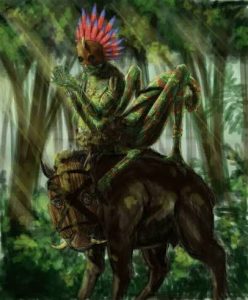
The Curupira is a figure from Brazilian folklore associated with protecting the forest and punishing those who harm it. One of the best-known features attributed to the being is its backward-facing feet, which confuse anyone attempting to follow its tracks.
That detail is widely repeated because it’s such a neat explanation for a hunter becoming lost. The tracks appear to lead in one direction while the creature has gone in another.
Some modern descriptions also attribute deceptive calls or imitated voices to forest beings in this broader family of stories. However, I wouldn’t confidently claim that human-voice mimicry is a universal or defining Curupira trait without a specific historical account to support it.
The distinction is important. The Curupira’s established association with the forest and the confusion of hunters gives us plenty to discuss without attaching every familiar woodland-monster ability to it.
Its role also differs from that of a creature that imitates a loved one. The Curupira is often presented as a protector of the forest, not simply a predator looking for an isolated victim. In stories about dangerous encounters, getting lost may be a consequence of violating the forest’s rules rather than an invitation deliberately designed to exploit personal trust.
That makes it a useful comparison, even if it is not the strongest example of literal voice imitation. Folklore often deals with misleading signs, deceptive tracks, strange sounds, and the difficulty of navigating unfamiliar places. These ideas overlap, but they shouldn’t be collapsed into a single supernatural power.
For a more detailed treatment, a useful next step would be to consult Brazilian folklore collections and ethnographic sources for specific regional versions of the Curupira, paying attention to which accounts actually mention vocal deception.
6. Why Does a Familiar Voice Make Such an Effective Monster?
There’s a practical difference between hearing an unfamiliar scream and hearing someone you know calling for help.
An unfamiliar sound gives you a reason to investigate, perhaps, but it doesn’t automatically tell you what to do. A familiar voice comes with an apparent identity and a social expectation. If your brother calls from outside, you might answer without thinking. If a child cries your name, ignoring it may feel impossible.
The folklore of deceptive voices plays on that ordinary response. In Aelian’s hyena story, the listener follows because the call sounds like something he recognizes. In the Nishi Daak stories, the apparent familiarity of the caller makes leaving home dangerous. The banshee uses a human-like lament for a different purpose, connecting sound with anticipated death rather than impersonation.
These are not necessarily variations of one original legend. Similar ideas can emerge independently because they draw on a common situation: people rely on voices to identify one another, especially when they cannot see the speaker.
There is also a straightforward natural explanation for some frightening sounds heard outdoors. Foxes can scream in ways that sound remarkably human, and other animals produce calls that are difficult to identify at night. Echoes, wind, and distance can make an ordinary sound seem to come from somewhere unexpected.
None of that proves that every historical report of an uncanny voice was a misidentified animal. It does mean that an unusual sound, by itself, cannot establish the presence of a supernatural creature.
The most useful question is often not whether the sound was frightening, but what the person reporting it believed they heard, what evidence was recorded at the time, and how the account changed as it was retold.
Sources and Further Reading
– Smithsonian Center for Folklife and Cultural Heritage, “In Search of the Irish Family Banshee, Her Cry Echoing Across Generations.” A discussion of Irish banshee traditions, variations in the reported cry, and storyteller Eddie Lenihan’s work. Read the article.
– Thomas Crofton Croker, Fairy Legends and Traditions of the South of Ireland. A nineteenth-century collection containing “The Banshee” and the story associated with Reverend Charles Bunworth. Useful for examining how Irish supernatural traditions were recorded and published. Read the digitized book at Project Gutenberg.
– USC Digital Folklore Archives, “The Banshee.” A collected contemporary account describing the banshee’s cry as a warning associated with death. This is a record of a reported belief, not proof of a supernatural encounter. Read the entry.
– The Pine Barrens Institute, “Cryptid Profile: The Wendigo.” A modern cryptid-oriented discussion of the wendigo and its portrayal in contemporary horror. It is useful for understanding modern representations, but claims about traditional Indigenous beliefs should be checked against culturally grounded sources. Read the article.