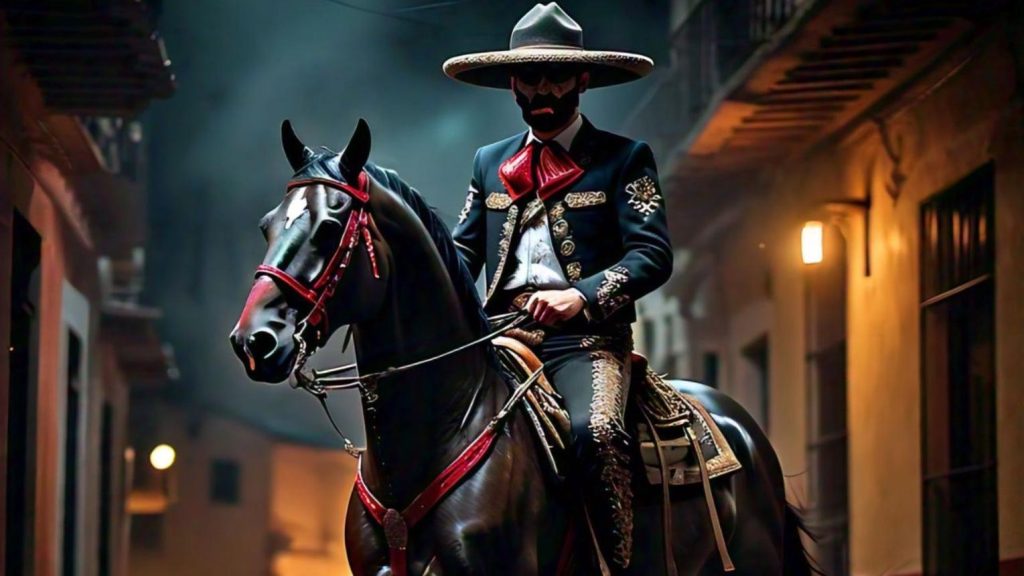
You’re walking along a quiet road after dark when you hear the sound of a horse behind you. There’s no ranch nearby, no streetlights, and nobody else around. You turn to look. A man dressed in black is riding toward you, sitting perfectly still on a large black horse. This scene sounds like something from a Mexican urban legend about a man on a horse, and it brings to mind one of Mexico’s best-known supernatural figures: El Charro Negro.
Who Is El Charro Negro?
The name El Charro Negro means “the Black Charro.” A charro is a traditional Mexican horseman known for his riding skills and distinctive clothing. A typical charro outfit can include a fitted jacket, decorated trousers, boots, and a wide-brimmed sombrero.
In ordinary life, there’s nothing frightening about a charro. The figure in the legend is different. He wears dark clothing, rides a black horse, and often appears at night. His clothes may look expensive, and he can seem like a wealthy gentleman rather than a monster.
That’s part of what makes the story interesting. He doesn’t always arrive looking like something evil. Sometimes he looks like a man who has money, confidence, and a very good horse.
Depending on the version, he may speak politely and offer help to a traveler. He might promise money, a ride, or some other reward. The person meeting him may believe they’ve had an unexpected stroke of luck.
But the encounter usually comes with a catch.
El Charro Negro is commonly linked to the Devil or to a soul that has been lost through greed and wrongdoing. In some retellings, he appears to people who are desperate for money. In others, he tempts travelers who are alone and vulnerable.
There isn’t one official version of the legend. Mexican folk stories have been passed around for generations, and people often change details when they tell them. One village might describe the rider differently from another. The important part is the warning behind the story: not every offer that seems too good to refuse is worth taking.
The Story of the Man on the Black Horse
One version of the story begins with a man who has serious money problems. He has debts he can’t pay, and no matter how hard he works, he can’t seem to escape them. He’s tired, worried, and willing to try almost anything to change his situation.
Then he makes a terrible decision. He turns to the Devil and agrees to a deal in exchange for wealth.
For a while, everything works out. The money comes, the debts disappear, and the man can finally live without worrying about his next payment. It seems like he made the right choice.
But the deal has a price.
When the man dies, his troubles don’t end. Instead of resting in peace, his soul is forced to serve the Devil. He becomes a rider dressed in black, traveling through the night on a black horse. Now he approaches other people who are struggling, offering them the same kind of temptation that once trapped him.
This version is recorded in the USC Digital Folklore Archives, where the story was shared by someone whose mother came from Puebla, Mexico. The details may vary elsewhere, but the central idea remains the same: the rider offers wealth to people who want it badly enough to risk everything.
The man who once wanted to escape his own problems becomes part of the problem for someone else.
It’s a cruel ending, and it gives the legend more weight than a simple story about a ghost on horseback. The rider isn’t just frightening people for fun. He’s a warning about what can happen when desperation takes control of your decisions.
What Happens When You Meet Him?
The most unsettling part of the legend is that El Charro Negro doesn’t always attack people as soon as he appears.
Sometimes he simply rides beside a traveler and starts a conversation. He may be polite, calm, and even helpful. If you’re walking along a dark road, having someone offer you a ride might seem like a blessing.
That’s exactly where the trouble begins.
In some versions, the rider offers a person a bag of gold or a large amount of money. In others, he invites them to climb onto his horse. The offer sounds harmless enough, especially if the traveler is tired or poor.
But accepting the offer can change everything.
The exact punishment isn’t always the same. That’s normal for an oral legend. People remember the central warning and change the smaller details as they pass the story along.
There is also a version in which the rider isn’t necessarily dangerous if you don’t accept his offer. He may accompany someone along the road and leave when they reach their destination. Some tellings say he disappears when he approaches a church.
That detail is especially interesting because it connects the story with Christian beliefs about the Devil and the protection offered by holy places.
Still, I wouldn’t take the friendly version as a reason to climb onto his horse. In these stories, the rider’s manners are part of what makes him dangerous. A monster that immediately attacks you is easy to recognize. A stranger who offers you exactly what you need is much harder to resist.
Why Does He Wear Black?
Black clothing is often used in ghost stories to suggest death, mystery, or something hidden. The horse adds another layer to the image. Horses are normally associated with travel, work, and ordinary life. In this story, an everyday animal becomes part of a supernatural encounter.
The charro outfit matters, too. El Charro Negro doesn’t usually appear as a random shadow or a creature crawling through the woods. He looks like a man who belongs to a recognizable Mexican tradition.
That makes the legend feel close to home. The figure is connected to familiar clothing, horses, rural roads, and the sort of traveler someone might actually meet outside a town.
His appearance also creates a strange contrast. The clothes may be elegant, the horse powerful, and the rider well-mannered. Yet the person beneath the sombrero may be something far more dangerous than he first appears.
Some descriptions portray him as handsome and wealthy. Others make him look ghostly, with a disturbing face or an unnatural presence. There isn’t a single appearance shared by every version of the story.
And that’s probably for the best. A mysterious face hidden beneath a wide sombrero leaves plenty to the imagination.
Is El Charro Negro the Devil?
Many versions connect El Charro Negro directly to the Devil, but the legend isn’t quite that simple.
In some stories, he’s a man who sold his soul and was condemned to ride forever. In others, he’s the Devil himself, taking the shape of a wealthy horseman to tempt people into making terrible choices. Both versions use the same basic idea: the rider offers something attractive, but accepting it can cost far more than the person expects.
The story also reflects the influence of different beliefs in Mexico. Catholic ideas about sin, temptation, and the Devil became mixed with Indigenous traditions and local folklore over time. The exact history of the character is difficult to pin down, and it’s better not to pretend that every community tells the same story.
The National Museum of Anthropology in Mexico has documented a figure associated with the Charro Negro in Cora and Huichol cultural traditions. This figure has connections with Indigenous religious ideas and is not simply identical to the Devil in Christian belief. That history shows why the character can mean different things in different settings.
So, is the horseman a ghost, a cursed man, or the Devil in disguise? It depends on which version you hear.
What stays consistent is the warning about temptation. The rider knows what people want, and he knows how to make a dangerous offer sound reasonable.
Where Does the Legend Come From?
The story is part of oral tradition, so finding one exact starting point isn’t easy. People have told and retold it in families, villages, and local communities. Each telling can add a new detail or give the rider a slightly different purpose.
One documented account comes from Puebla, while a Mexican government educational resource records a local story called La curva del charro negro — the curve of the Black Horseman. In that tale, people report hearing the rider making a disturbance around the town’s government building at night. A local man eventually tries to confront him, after which the strange appearances stop.
In one place, he may be a supernatural stranger who offers gold. Somewhere else, he’s a frightening nighttime rider whose appearance becomes a local mystery.
That’s how folklore survives. It doesn’t need one author, one official story, or a fixed ending.
Why Is the Black Horseman So Scary?
For me, the strongest part of this legend is how ordinary the encounter begins.
Imagine walking home late at night. The road is quiet, your phone battery is almost dead, and you still have a long way to go. Then you hear hooves behind you.
You turn around and see a man on a black horse. He isn’t running at you. He isn’t making strange noises. He simply asks whether you’d like a ride.
That’s a much more effective setup than a creature jumping out of a bush.
The rider gives you a choice, and that’s important. You can refuse him. You can keep walking. But what if you’re exhausted? What if you’re cold? What if you’ve been struggling with money for months and he offers you enough gold to solve every problem you’ve got?
The legend makes the danger personal. The rider doesn’t have to chase everyone he meets. He only needs to find someone who wants what he’s offering.
There’s also something unsettling about the horse itself. A black horse moving along an empty road at midnight is already a striking image. Add a rider whose face is hidden by a sombrero, and you have something people can remember long after the story ends.
And unlike a creature that lives in a distant cave, this one can appear on a road you know. That’s what makes the story easy to imagine in your own town.
What El Charro Negro Teaches Us
The Mexican urban legend of the man on the horse isn’t just about being afraid of the dark. It’s about the choices people make when they feel they have nothing left to lose.
The rider offers shortcuts. He promises money, comfort, or an easier life. For someone who has struggled for years, those promises can sound better than they should.
That’s why the legend still works. People don’t need to believe in ghosts to understand the fear behind it. We’ve all heard stories about deals that looked wonderful at first and turned into disasters later.
Of course, nobody can prove that a supernatural horseman rides the roads of Mexico. The stories belong to folklore, not verified reports of a real creature. But legends don’t have to be true in a literal sense to stay with people.
El Charro Negro has a memorable appearance, a simple but effective story, and a warning that doesn’t need much explanation.
So the next time you’re walking along a lonely road and hear the sound of hooves behind you, remember the Black Horseman.
And if a well-dressed stranger on a black horse offers you a bag of gold, you might want to keep walking.
Some offers are better left unanswered.
Sources and further reading
-
USC Digital Folklore Archives — Charro Negro — A version of the legend shared by someone with family roots in Puebla.
-
Spanish Institute of Puebla — Charro Negro — Another traditional telling of the story.