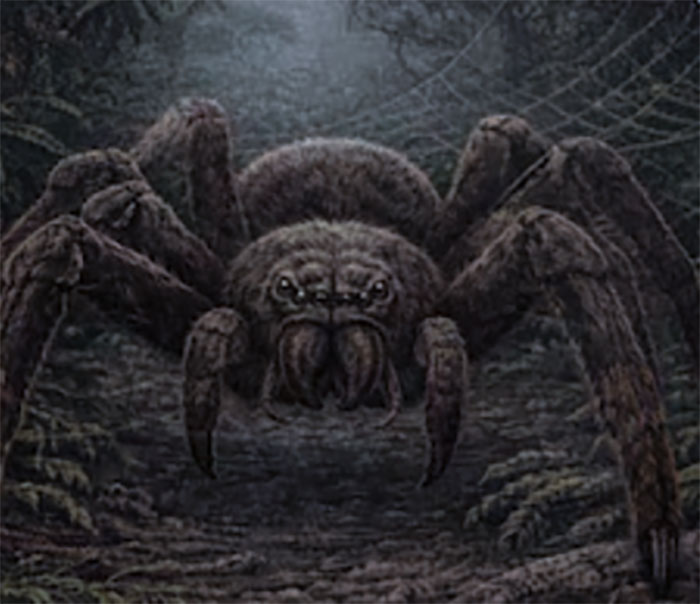
If you’ve never heard of this thing, buckle up. The J’ba Fofi (sometimes spelled j ba fofi) isn’t your average garden-variety arachnid. We’re talking about a cryptid: a giant, dog-sized spider allegedly lurking in the dense rainforests of the Democratic Republic of Congo. Stories about the creature are often linked to Indigenous communities in Central Africa, although the origins of the legend are harder to establish than many websites make it sound.
And ever since I stumbled across this thing, I’ve been obsessed with one question above all others: j ba fofi size — just how big are we really talking?
Some accounts describe a spider with a leg span of three or four feet. Others push that figure to five or even six feet. At that point, we’re no longer talking about an unusually large house spider. We’re talking about an animal that could stretch across a doorway.
Let me set the scene.
The name “J’ba Fofi” is commonly translated as “giant spider” in cryptozoological accounts. The name is frequently associated with the Baka people of the equatorial forests, though the precise linguistic and cultural history deserves more scrutiny than it usually gets in online retellings.
According to the stories, the spider has a large, hairy body and thick legs resembling those of a tarantula, only far more muscular. Some descriptions compare its body to a grapefruit, while the legs supposedly spread several feet from side to side.
When I first read that, I thought, “No way.” But then I kept digging.
The interesting part isn’t simply the size. It’s how a creature this extraordinary became a recognizable name in cryptozoology despite the absence of a verified specimen.
J’ba Fofi Size: Three Feet, Five Feet, or Six?
The first thing I noticed while researching the j ba fofi size question was that the numbers aren’t consistent.
The Atlas of Cryptids gives a reported leg span of approximately 0.9–1.2 meters, or three to four feet. Other modern accounts use estimates of four to six feet. These figures are claims attributed to stories about the creature, not measurements taken from a captured spider.
That distinction matters because a spider’s leg span is not the same as its body length. A spider can spread its legs over a surprisingly wide area while having a much smaller central body.
Still, even the lower estimates would be startling.
Imagine walking along a muddy forest trail and seeing something the width of a small coffee table moving between the roots. Your first instinct probably wouldn’t be to stop and count its legs. You’d be too busy reconsidering your plans for the afternoon.
A five-foot leg span would be an especially extraordinary claim. It would place the J’ba Fofi far beyond the dimensions of the largest living spiders recognized by zoologists.
Here is the comparison that puts the legend into perspective:
| Spider | Approximate leg span |
|---|---|
| Giant huntsman spider | Up to about 12 inches |
| Goliath birdeater | Up to about 11 inches |
| J’ba Fofi, according to some accounts | Allegedly 3–6 feet |
The first two are real spiders with documented biological characteristics. The J’ba Fofi measurement comes from unverified reports.
That’s a substantial gap, and it is one of the main reasons the creature remains a cryptid rather than a recognized species.
The 1938 Encounter: Where the Modern Story Begins
One of the most important details I found is that the J’ba Fofi story has a much narrower documentary trail than the number of websites discussing it might suggest.
The best-known account concerns Reginald and Marguerite Lloyd, a couple said to have encountered an enormous spider while traveling through the Belgian Congo in 1938.
According to later retellings, the couple were driving along a forest track when a large animal crossed the road in front of their vehicle. At first, it was apparently mistaken for a small mammal. A closer look supposedly revealed something resembling an enormous spider.
The creature reportedly disappeared into the vegetation before a photograph could be taken.
It’s a fantastic scene. You can almost picture the driver braking, both occupants staring through the windscreen, and then watching the thing vanish into the undergrowth.
But here is the detail that changes how I read the story: the account was reportedly passed down through the couple’s family and popularized decades later by cryptozoologist William Gibbons. The Atlas of Cryptids notes that the story lacks a surviving photograph or physical specimen.
In other words, we don’t have a contemporary field report that can be checked against other records from 1938. We have a story attributed to an earlier encounter and repeated in later cryptozoological literature.
That doesn’t automatically mean the witnesses invented it. It does mean that the details are difficult to verify independently.
This distinction is surprisingly important. If several websites repeat the Lloyd story, it can look as though several independent sources confirm the encounter. But if they all trace back to the same account, we’re still dealing with one story.
The number of pages repeating a claim is not the same as the number of independent witnesses.
The William Gibbons Connection
Another name that repeatedly appears in J’ba Fofi research is William Gibbons, a cryptozoological researcher known for expeditions in search of the alleged Central African creature Mokele-mbembe.
Modern accounts attribute additional giant-spider reports to information Gibbons said he gathered from Baka elders and hunters in Central Africa during the 2000s. These descriptions reportedly involved large, brown spiders, concealed burrows, and silk structures used to catch prey.
This gives the J’ba Fofi story a second strand beyond the Lloyd encounter. However, the crucial question is whether these reports can be independently traced to identifiable informants and documented fieldwork.
I couldn’t establish a separate, well-documented zoological investigation that produced physical evidence of the creature.
That doesn’t mean the people described in these accounts should be dismissed. It means we need to distinguish between testimony reported by a researcher and a finding that other researchers can independently test.
There is also a cultural issue here. The Baka and Mbuti are distinct peoples, not interchangeable labels for the inhabitants of Central African forests. Modern cryptid websites sometimes associate the J’ba Fofi with one group and sometimes the other. I couldn’t establish reliable ethnographic evidence confirming that the specific giant-spider narrative, in the form now circulating online, is a well-documented traditional belief shared by either community.
I would rather leave that question open than confidently attribute a modern internet legend to an entire Indigenous culture without adequate evidence.
What Does the J’ba Fofi Supposedly Do?
The descriptions become particularly interesting when they move away from size and start discussing how the spider supposedly hunts.
Some accounts describe the J’ba Fofi as a ground-dwelling ambush predator. Instead of building a conventional web high between branches, it allegedly uses concealed retreats and silk strands placed across animal trails.
The idea is that an animal walking through the forest disturbs the silk, alerting the spider to its presence. The spider then emerges from hiding.
This is one of the more intriguing parts of the legend because real spiders use a variety of hunting methods. Some build elaborate webs, others actively pursue prey, and some wait inside burrows where they can detect vibrations from nearby movement.
There is an important limit to that comparison, though. Real trapdoor spiders and other burrowing species demonstrate that concealed ambush hunting is possible. They do not demonstrate that a spider with a five-foot leg span exists.
I also found claims about funnel-shaped burrows and leaf-covered entrances. These details are repeated in modern cryptozoological descriptions, but I couldn’t verify them as observations made by zoologists studying a known J’ba Fofi population.
The same caution applies to claims that the creature has exceptionally powerful venom or routinely attacks humans. Those are dramatic details, but without a verified animal, they remain unconfirmed parts of the story.
J’ba Fofi Caught on Camera: What Are Those Videos Actually Showing?
This was the part I really wanted to investigate. I spent an embarrassing amount of time searching for j ba fofi caught on camera, hoping somebody had finally produced a clear recording.
There are illustrations, documentary-style videos, and clips associated with the legend. Some show enormous spiders in dark forests, while others use blurry footage or dramatic reconstructions.
But there is a problem with treating any of these as proof: a video can depict a cryptid without documenting a real animal.
I couldn’t independently verify the specific 2015 footage allegedly recorded near the Ubangi River that appears in some retellings. Without a traceable original recording, a verifiable filming location, and an independent identification of the animal, I wouldn’t describe it as confirmed evidence.
A fast-moving shape on a muddy riverbank could be many things. Poor lighting can hide important features, and perspective can make an ordinary animal appear much larger than it really is.
For a video to become genuinely useful evidence, I’d want to know who filmed it, where and when it was recorded, whether the original footage is available, and whether there is an object of known size in the same frame.
Most importantly, a qualified expert would need to examine the animal’s visible characteristics rather than simply accept the uploader’s identification.
Until that happens, the supposed footage is an unresolved claim, not a documented discovery.
And yes, I admit that’s disappointing. A clear photograph would make this investigation considerably more exciting.
J’ba Fofi Existe: Does the Giant Spider Actually Exist?
Naturally, I started asking the big existential question: j ba fofi existe — does it actually exist?
Searching in French opens another route into the discussion. French-language records are important when researching the history of Central Africa, but a search result written in French isn’t automatically a reliable account of local beliefs or colonial-era observations.
The broader question is whether an undiscovered spider species could exist in the forests of Central Africa.
Absolutely. Undiscovered invertebrates are a reasonable subject for scientific research. Central Africa contains vast tropical forests, winding rivers, swamps, and seasonally flooded woodlands, supporting an extraordinary variety of wildlife and plant life.
The region’s vast rainforests contain remarkable biodiversity. Their sheer scale helps explain why researchers continue to study their wildlife, but it is not evidence that the J’ba Fofi exists.
That is a good reason to remain curious about new species. It is not a reason to accept every extraordinary animal report.
The J’ba Fofi’s alleged size creates a much bigger problem than the possibility of an unknown spider. A spider with a leg span of several feet would be far outside the dimensions of the largest known living species.
The most defensible answer is that the J’ba Fofi has not been scientifically confirmed. There is no verified specimen, DNA result, or authenticated photograph establishing a spider with the dimensions described in the stories.
The Real Spiders That Make the Legend More Interesting
To understand why the J’ba Fofi is so extraordinary, it helps to look at the real animals that may have inspired comparisons.
The Goliath birdeater
The Goliath birdeater (Theraphosa blondi) is among the heaviest known spiders. It lives in northern South America, not Central Africa, and has a broad, hairy body with thick legs.
Its impressive appearance makes it an obvious comparison for the tarantula-like creature described in the J’ba Fofi stories.
But its leg span is around 11 inches at the upper end of commonly cited measurements, not several feet. The species is real, studied, and identifiable. The J’ba Fofi remains an unverified report.
Why a Five-Foot Spider Would Be Such a Big Deal
Here’s where the skeptic in me becomes difficult to silence.
If a spider with a five- or six-foot leg span really lived in the remote rainforests of Central Africa, wouldn’t we expect somebody to find a shed exoskeleton, a carcass, or a clear photograph?
Spiders periodically shed their external skeletons as they grow. A large shed exoskeleton could be especially useful evidence because researchers could examine its anatomy and potentially identify the animal that left it behind.
The Atlas of Cryptids makes this point directly: no photograph, preserved web, or shed exoskeleton has been presented as physical evidence of the J’ba Fofi
That absence doesn’t logically prove that no witness has ever seen an unusual spider. It does mean the creature’s most extraordinary claims remain unsupported.
There is another problem: spider biology.
Spiders breathe through structures such as book lungs or tracheal systems, depending on the species. Their external skeleton and physiology place constraints on how large they can grow. Scaling a spider up to the dimensions described in the J’ba Fofi accounts would create serious biological challenges.
This is why the giant-spider story is not simply a question of whether the rainforest is large enough to hide an unknown animal. A hypothetical species would also need to fit what we know about how spiders function.
Could an unfamiliar species be discovered? Certainly.
Would that automatically make a six-foot spider plausible? No.
The Okapi Comparison: An Interesting but Incomplete Argument
The okapi sometimes enters discussions of the J’ba Fofi as an example of an animal that was known locally before it was formally recognized by Western zoologists.
I understand the appeal of the comparison. It reminds us that scientific discovery is not the same as the moment an animal first becomes known to people living alongside it.
But the okapi is not evidence for the J’ba Fofi. The two cases involve different animals, different evidence, and different historical circumstances.
The useful lesson is that local knowledge deserves serious attention and should be documented carefully. It isn’t that every cryptid account will eventually be confirmed.
For the J’ba Fofi, we still need independently documented testimony and physical evidence capable of establishing what the animal is.
Araña J’ba Fofi and J’ba Fofi Spinne: How the Story Travels Online
I also looked at the international side of the story.
Searches for araña J’ba Fofi and j ba fofi spinne lead into Spanish- and German-language discussions of the alleged creature. The legend has an obvious appeal across languages: a giant spider in a remote rainforest is an immediately understandable horror story.
But the same source problem follows it from one language to another.
Several websites can repeat a single account, translate it, add an illustration, and make it look like a fresh report. Unless the underlying witness or source is new, the translation does not add independent evidence.
I couldn’t verify the claim that the J’ba Fofi is currently a trending topic in Latin American cryptid communities, nor could I establish a reliable network of Spanish-speaking researchers compiling independently documented reports from Congolese immigrants.
Those claims may sound plausible, but they need specific evidence before they belong in an article as established facts.
The alleged “spider honey” is another example. Some retellings claim the J’ba Fofi produces a sticky substance used to coat arrow tips. I couldn’t find reliable documentation establishing that biological claim or linking the practice to a specific community.
It is an unusual detail, and unusual details can make a story memorable. But being memorable is not the same as being verified.
For me, the most revealing discovery was not a new photograph or a newly identified witness. It was realizing how much of the modern story appears to depend on a relatively small number of accounts.
So After All That, Where Do I Land?
I’m still somewhere between skepticism and curiosity. If you forced me to put numbers on it, I’d say I’m 60% skeptic and 40% believer. That’s a personal way of describing my feelings, not a scientific estimate of the creature’s probability of existence.
I think there could be something behind some of the stories. Perhaps people have encountered unusually large spiders. Perhaps a known animal was misidentified in poor light. Perhaps the legend has grown more dramatic as it passed between witnesses, researchers, books, and websites.
What I can’t confidently accept is the claim that a spider with a five- or six-foot leg span is currently living in the forests of the Congo.
The evidence simply isn’t there.
But I also don’t think the story needs to be presented as established fact to be worth investigating. The history of the reports, the way the legend spread, the relationship between eyewitness testimony and physical evidence, and the biology of real giant spiders all make for interesting research.
Honestly? I want the mystery to be real. Not because I want to meet one—hell, no—but because the natural world is still full of things worth discovering.
If somebody eventually produces a properly documented specimen, a shed exoskeleton, or a clear photograph that experts can independently examine, I’ll happily revisit the question.
Until then, the J’ba Fofi remains a fascinating cryptid with an extraordinary size claim and no verified specimen to back it up.
And if a five-foot spider really is out there somewhere, I hope the first person to find it brings a measuring tape.