However, researchers who have dug into historical records have found something interesting. Despite the claim that sightings date back to 1887, there is little to no documentary evidence of the Dogman in Michigan newspapers or folklore collections before 1987. This doesn’t necessarily mean everyone is lying, but it does suggest that the modern wave of sightings was heavily influenced by the song and the media attention that followed. In other words, once people had a name and a description for what they were seeing, they began to interpret strange encounters through that lens.
What Do Witnesses Actually See?

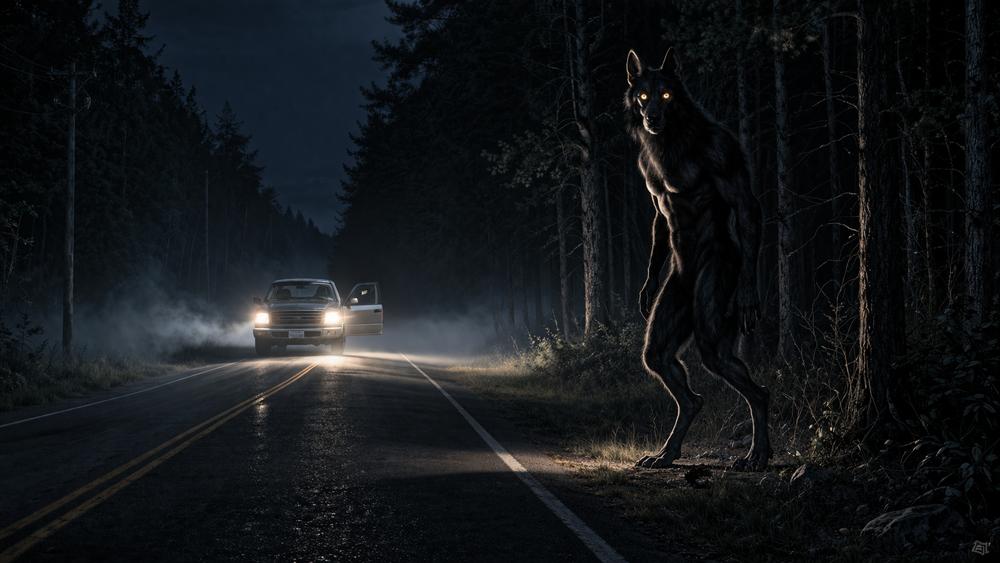
If you spend enough time listening to witness accounts, certain patterns begin to emerge. Most descriptions of Dogman include a few consistent features. The creature is almost always described as bipedal, meaning it stands and walks on two legs like a human. Its height is often reported as being between six and eight feet tall, though some claims push it to nine feet. The head is consistently described as canine, resembling a large dog or wolf, but the body is more humanoid, with broad shoulders and long arms. Witnesses frequently mention glowing eyes, usually yellow or amber, and a distinct odor that is often compared to rotting meat or wet fur.
Behaviorally, the accounts are more varied. Some witnesses claim the creature simply stood and watched them before disappearing into the woods. Others describe aggressive behavior, such as chasing vehicles, scratching at tents, or killing livestock. A retired sheriff’s deputy in Alabama once reported a daylight encounter where a large white Dogman crossed the road in front of his patrol car and then stopped to face him, an experience he described as deeply unsettling because the creature seemed intelligent and aware. In Texas, a man fishing with his brother captured video of a creature that stood upright, looked toward them, and then bolted away on all fours with incredible speed. These stories share a common thread: the witnesses are left with the unshakable feeling that what they saw was not a normal animal.
The Community of Believers and Witnesses
Despite the lack of hard evidence, the Dogman phenomenon has spawned a dedicated community of researchers, podcasters, and witnesses. Vic Cundiff, host of the podcast Dogman Encounters Radio, has interviewed more than 600 people who claim to have had experiences with the creature. Cundiff is careful to note that his goal is not to prove the Dogman exists, but rather to provide a safe space for people to share their stories, many of whom are deeply traumatized by what they believe they saw. This trauma-informed approach is echoed by other investigators, like Lance Hightower, who has documented thousands of reports through his Creature Report Hotline. Some witnesses even claim to have been visited by mysterious government officials who warned them to stop talking about their encounters, adding a layer of conspiracy theory to the already strange narrative.
These communities serve an important social function. For people who have had an experience they cannot explain, finding others who believe them can be profoundly validating. Whether the Dogman is real or not, the community that has grown around it is very real, and the stories they share are often deeply personal and emotionally charged.
Physical Evidence and the Search for Proof
If Dogman is a real, physical creature, there should be physical evidence. This is where the case for the creature weakens considerably. No body has ever been recovered. No clear, unambiguous photographs or videos exist. No DNA samples have been confirmed as belonging to an unknown species. The tracks and claw marks that are sometimes presented as evidence are always inconclusive, often attributable to known animals or simply not documented well enough to be analyzed scientifically.
The videos and photos that circulate online are almost always blurry, taken from a distance, or otherwise easily explained. The fact that in an age when nearly everyone carries a high-definition camera in their pocket, we still lack a single clear image of a Dogman is a significant problem for believers. Some argue that the creature is intelligent and avoids being photographed, but this is an unfalsifiable claim that cannot be tested. For now, the physical evidence remains absent, and the case rests entirely on eyewitness testimony.
Why the Story Endures
So why does the Dogman legend persist? Part of the answer lies in human psychology. We are drawn to mystery and to stories about things that cannot be easily explained. The idea that there might be a hidden world of creatures living just beyond the edge of our maps is exciting and terrifying in equal measure. It taps into something primal, a fear of the dark woods and the things that might be watching from them.
There is also a regional pride at play. In Michigan, the Dogman has become something of a local mascot, a unique piece of folklore that belongs to the state in a way that Bigfoot, with its Pacific Northwest associations, does not. The legend has inspired songs, films, festivals, and a thriving tourist industry. For many people, the truth of the creature matters less than the story itself.