It appears in Wirt Sikes’s British Goblins (1880), and it was done in coal by a Welsh peasant. The creature has a head rather like a fledgling bird’s and a figure not unlike a tadpole’s. Another writer, quoting Louise Imogen Guiney, gives a different description of the same kind of picture: a queer little figure, long and grotesque, looking something like a chicken half out of its shell.
Think about that for a second. This is not a Victorian illustrator’s fairy with wings and a flower crown. This is a portrait made by someone who may well have believed in the thing. And what they drew is a strange, unfinished, slightly pitiful little creature. Nothing about it is pretty.
That drawing is the reason I wanted to write about the Pwca. Almost everything else we know about it comes through collectors, poets and playwrights. That scribble in coal is the closest we get to what a Welsh farmhand actually pictured when he heard the word.
What is a Pwca?
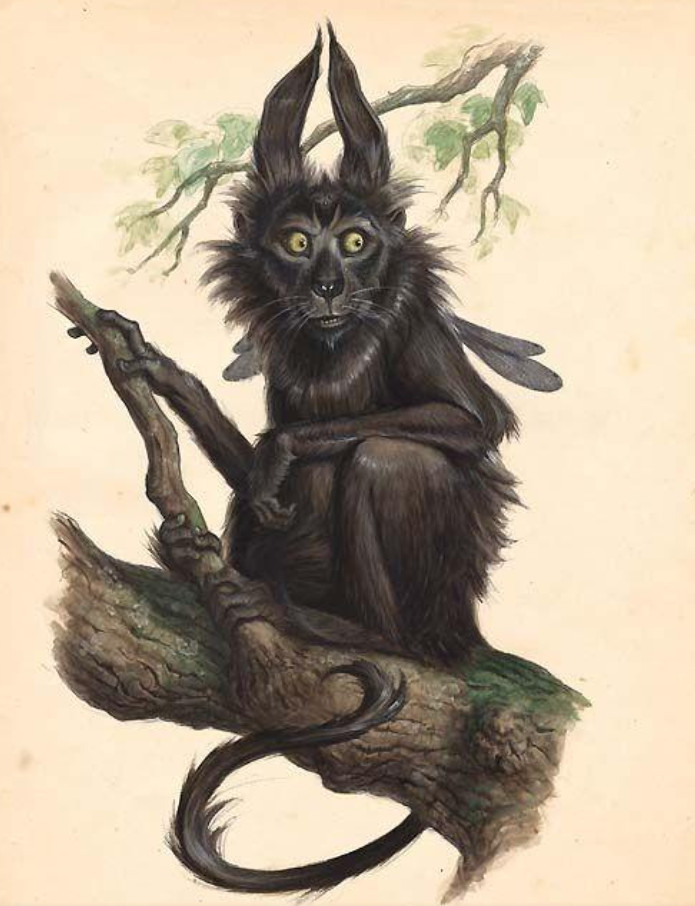
The Pwca is a Welsh goblin, a shape-shifting trickster that lives in the countryside and sometimes in the house. Katharine Briggs calls it the Welsh version of the English puck, and says it is best known as a Will o’ the Wisp. That last part matters, and I’ll come back to it.
It has cousins everywhere. In Cornwall it’s the bucca, in Ireland the púca or pooka, and the creature turns up across Celtic and English folklore and in the Channel Islands too. One folklore summary I found sums up the family like this: the Irish version is feared and respected, the English Puck is playful and theatrical, and the Welsh Pwca is more of a household spirit, offering blessings in exchange for respect.
That is a handy rule of thumb, though I wouldn’t take it too literally. Folklore never sorted itself into neat national boxes. The Pwca is a trickster first, and a helper when it feels like it.
The lantern in the dark
Now, the Will o’ the Wisp.
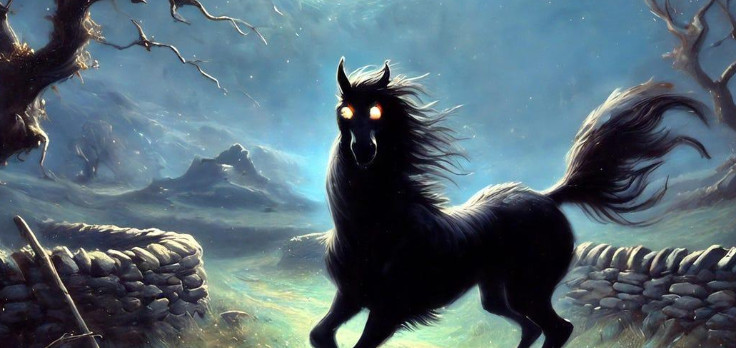
In Welsh stories the Pwca could lead travelers astray with a light. The tale goes that it would guide people along with a lantern, then blow the light out when they were standing at the edge of a cliff.
I find this much scarier than any monster with teeth. There’s no chase and no growling. Just a friendly little light, bobbing ahead of you on a dark road, and you follow it because it seems to know the way. Then it vanishes.
It is a very old fear in a very practical form. Anyone who has walked unfamiliar country at night, with fog on the ground and only a vague idea of where the path is, knows how much you trust the one thing you can see. The Pwca turns that trust into a trap.
Sikes also collects stories of the Pwca in a gentler mood, and he writes about it alongside the Ellylldan, the “fire sprite” of marsh lights. The two are closely tied. When Welsh people saw odd lights over bogs, the Pwca was one of the answers.
A name that got lost on the way
This is the part that surprised me most.
The word pwca has traveled a long way, and nobody is totally sure where it started. One dictionary quotation I found says the púca occurs in later legend and seems to have no basis in myth, probably being an import from the Norse púki, an imp, from where it also went into Welsh pwca and into English as puck. Other writers point to Old English puca, “goblin.” The experts disagree, and I’m not qualified to settle it.
What I like is that the word behaves like the creature. It wanders. It shows up in Ireland, in Wales, in Cornwall, in England and the Channel Islands, wearing a slightly different spelling every time: pooka, phouka, pwca, bucca, puck. Try to pin down its home and it slips off down another path, with the light going out behind it.
Did Shakespeare steal him from Wales?
Here is the famous question. Puck, the mischievous spirit in A Midsummer Night’s Dream, is one of the best-known fairies in English. Is he Welsh?
Some Welsh people have said yes. The story goes that Shakespeare borrowed the character from tales told to him by his friend Richard Price of Brecon, who lived near Cwm Pwca, one of the Pwca’s favorite haunts. Cwm Pwca, “Puck Valley,” is a real place name in Breconshire, near Clydach, and Sikes devotes a section of his book to it.
I want to be careful, because this claim is the kind of thing that is lovely to believe. Sikes himself is skeptical. In his words, as quoted in a 1919 book, the allegation seems to rest on no more obvious basis than the dramatist’s mother being of Welsh descent, and that book’s author adds that the Welsh blood actually came from his father’s side. In other words, the whole thing hangs on a rumor and a family tree that people got wrong.
Another important point: before Shakespeare, Puck and Robin Goodfellow were generally considered separate creatures, and after him they came to be seen as the same one. So even if Wales did contribute something, English folklore had its own puck long before the play. My honest summary is “possible, unproven, and a fun story either way.”
Why a drawing matters
I keep coming back to the coal drawing.
Most of the fairy images we know are from artists who were never afraid of the thing they painted. Victorian fairy painting is full of delicate, glowing people. They were made for drawing rooms.
The Pwca in Sikes’s book was made by someone who lived in the landscape the Pwca haunted. A head like a baby bird. A body like a tadpole. It has the proportions of something half-formed, caught between shapes, and that fits a creature known for changing form.
Maybe that is just a coincidence of a shaky hand and a piece of charcoal. But I like to think the artist drew what they felt: that the thing in the dark doesn’t have a finished shape, because it could be anything.
What it might be doing for people
I don’t think stories like this survive just because they’re spooky. They survive because they’re useful.
A lantern-faced spirit that lures you to a cliff is a story about bog lights and bad paths. Parents could tell it to children to keep them off the moor at night. Travelers could tell it to each other as a reminder to stay on the road and not trust a light you can’t explain. A trickster that is sometimes helpful and sometimes dangerous is a way to talk about a land that is exactly that.
The same goes for the household side. A spirit that does favors if you show respect and plays tricks if you don’t gives a community a script for good manners towards the unknown. Be polite, don’t take it for granted, and don’t be surprised if the rules change overnight.
If you want to go looking
If you’re curious, the best starting point is British Goblins itself. It’s out of copyright and free on Project Gutenberg. The chapter on Welsh fairies covers the Pwca, Cwm Pwca and the “usual form of the Pooka story,” and it includes the coal drawing. Read it with a pinch of salt, because Sikes was a Victorian collector with his own theories. But the stories themselves are wonderful.
And if you ever find yourself on a dark Welsh hillside, and a small, friendly light bobs up ahead of you, offering to show you the way?
Maybe stop and wait for daylight.