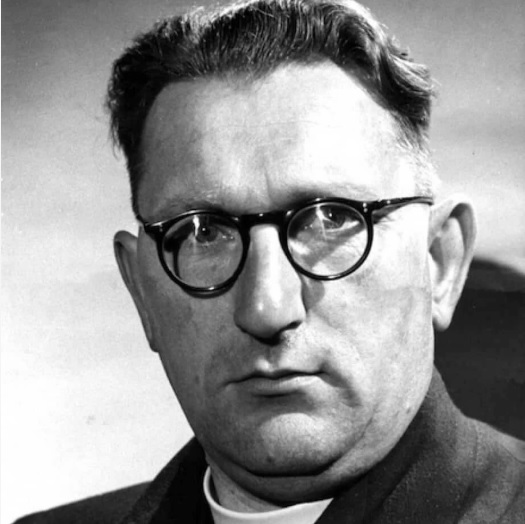
A warm Monday evening in Bradford, West Yorkshire. Nothing special about it. Just another summer night. At 82 Little Horton Lane, a Polish priest picks up the phone. His housekeeper, Irena Beck, is in the next room. She hears his voice go strange. Clipped. Quiet. He’s speaking Polish, which isn’t unusual, but there’s something off. She catches a few words. The only ones she remembers clearly are: “All right, I go.”
He grabs his hat and coat. Weird, right? It’s summer. He steps out the door. And that’s it. He never comes back.
Irena Beck waited. And waited. Hours passed. The priest didn’t return. She called the police the next morning. And that’s when the nightmare really began.
Henry Borynski was no ordinary priest. He was a mountain of a man. Six feet tall, fourteen stone. Former chaplain to the Polish Second Corps. A scholar. A man of deep faith and fierce opinions. He hated the Soviet regime with a burning passion. His sermons at St. Joseph’s Church were fire and brimstone. He didn’t just preach about God. He preached about freedom. About resistance. About standing up to tyranny.
For the 1,500 Polish refugees living in Bradford, he was everything. A symbol of hope. A voice from home. A man who understood what they had lost and what they were fighting for. These were people who had escaped the horrors of war, only to find themselves trapped in a new kind of fear. The Cold War was at its iciest. The world was divided. And the Soviet Union had a long reach. Its agents were everywhere, even in quiet English cities like Bradford.
Borynski had made himself a target. He knew it. He didn’t care. He had joined protests against Soviet agents who were pressuring refugees to return to Eastern Europe. He had given sermons that condemned the regime in Warsaw. He was loud. He was visible. He was dangerous to the wrong people.
So when he vanished, the community wasn’t shocked. They were terrified. This was the Cold War. People disappeared. Dissidents were silenced. Exiles were dragged back to face prison camps or worse. The priest had enemies. Powerful enemies. Enemies who didn’t play by the rules.
But here’s where it gets even stranger.
Borynski had actually received two phone calls that evening. The first came from a man pretending to be his predecessor, Canon Martynellis. Martynellis had been disgraced, removed from his position. Not exactly someone you’d trust. But Borynski went anyway. He visited Martynellis, found no summons, and came back home.
Then the second call came.
He didn’t tell Irena Beck who it was. He just said goodbye and left. But he told a parishioner at the bus stop something strange. He said he was going to “play detective.”
What did he mean by that? Did he know he was walking into a trap? Was he trying to solve something? Or was he just deflecting, trying to seem casual when he was actually terrified?
He was last seen waiting at a bus stop near St. Luke’s Hospital. That was it. No witnesses after that. No trail. No body. Nothing.
The police didn’t take it seriously at first. The official line in Parliament was that there was “no evidence of foul play.” Can you believe that? A priest vanishes into thin air, and they say there’s no evidence? The Polish community was furious. They knew something was wrong. They could feel it in their bones.
Nine years passed. Nothing. Then a rumor spread like wildfire. A Soviet spy had confessed to the murder. He had been in Bradford. He had been involved. The details were vague, but the community didn’t care. They needed answers. So over 3,000 Poles and Ukrainians marched onto Ilkley Moors. They searched for hours. Days. They found nothing.
The investigation involved MI5 and Scotland Yard. The files were declassified years later, but they were heavily redacted. Names blacked out. Crucial details missing. An official report even criticized the lead investigator, describing him as “on the eve of retirement, and mentally somewhat beyond it.” Pretty damning, right? The man in charge of finding Henry Borynski was checked out.
Father Borynski was declared legally dead in 1959. A requiem mass was held at St. Joseph’s Church. The Church gave its final answer. But the community never stopped asking questions. They never stopped wondering what happened to their priest.
So what did happen?
Was he taken by Soviet agents? The Cold War was full of such stories. Dissidents disappeared in the night. Exiles were silenced. The Soviet Union had no problem eliminating its enemies, even on foreign soil. Borynski had been a vocal critic. He had made himself a target. Maybe the first call was a warning. Maybe the second was the trap. Maybe he knew exactly what he was walking into and went anyway.
Was it something more personal? Martynellis was disgraced. Maybe there was bad blood between the two priests. Maybe the first call wasn’t a setup at all. Maybe it was part of a larger scheme. A personal vendetta disguised as something else.
Or maybe, just maybe, he walked away. Some people whisper that he started a new life somewhere else. But would a man like that abandon his community? His faith? His mission? It doesn’t fit. It doesn’t feel right.
His housekeeper Irena Beck never recovered. She got rid of the telephone in her home. Couldn’t stand the sound of it anymore. She and her husband lived the rest of their lives haunted by that night. The guilt of not stopping him. The shame of not asking more questions. The image of a priest grabbing his hat and coat and walking into the darkness.
Today, Henry Borynski is a ghost. A footnote in the archives of the disappeared. A forgotten figure swallowed by the fog of history. But his story stays with you. It’s the kind of mystery that makes you question everything. How does a man vanish? How does a community live with that silence? How does a housekeeper ever answer the phone again?
The Cold War claimed many victims. Some were famous. Some were soldiers. Some were spies. And some were just priests who spoke too loudly and loved their people too much.
Father Henry Borynski was one of them. And somewhere out there, maybe in a declassified file or an old memory, the truth is still waiting. But for now, all we have is silence.
And that silence is deafening.