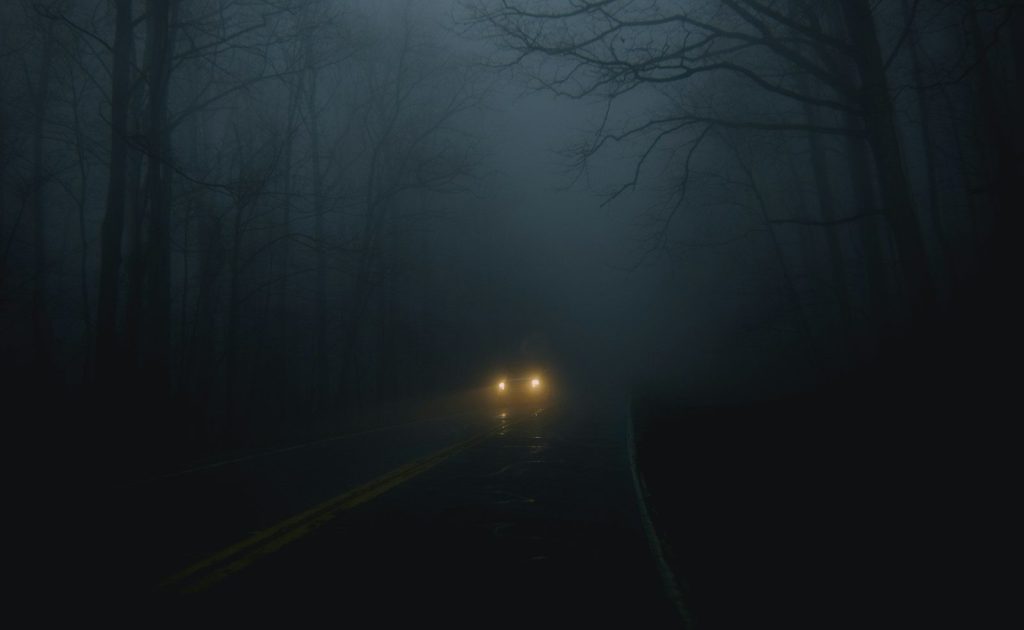
There is a specific stretch of road where these phantom hitchhikers get picked up. That’s the first thing. Not the road itself. Not the weather. The stretch.
It’s always a straight bit with nothing on either side. No houses. No turnoffs. No lights. Just asphalt and darkness and the kind of silence that makes the engine sound louder than it is. And that’s where they stand. On the shoulder. One arm out. Thumb up. Waiting.
The detail everyone misses is the direction they’re facing. Every other hitchhiker on every other road in the world faces the traffic coming toward them, because that’s the side of the road you stand on, because that’s how you get picked up. These ones face the other way. They stand on the shoulder with their backs to the oncoming lane and their thumbs out toward the empty road ahead, as if they’re waiting for something coming from the direction they’re already going.
Which means they never see the car that stops for them. Which means they only ever turn around after the car has already pulled over. Which means the first thing anyone ever sees of them is the back of a head, turning, slowly, in the dark.
Never Travel in Pairs
Never two of them. Never a couple, never a pair of friends, never a family with a suitcase. One figure. Standing on the shoulder. In the middle of nowhere. At an hour when nobody should be walking anywhere.
That’s the second thing. Not the figure. The hour. Look at the clock when it happens. It’s never eight in the evening. It’s never the grey part of dusk when normal people are still driving home. It’s the deep part. The part with a number on it that nobody likes to say out loud. And the road at that hour is empty in both directions, which means there is no explanation for how a person got there, and no explanation for how they intend to leave.
They don’t have a bag.
This is the detail that should stop anyone from pulling over, and never does. Hitchhikers have bags. Hitchhikers have backpacks, duffels, plastic bags, something. Anyone standing on a road at the edge of the world at that hour is going somewhere, and people who are going somewhere carry something.
They carry nothing. Hands empty. Or one hand empty and the other in a pocket, which is worse, because a pocket is a place to keep something you don’t want seen.
The Car Knows Before the Driver Does
It starts with the temperature. Not outside. Inside. The heater is on and the vents are blowing and the air in the car gets cold anyway, in a way that doesn’t spread evenly, in a way that settles into the seats first and the floor second and the driver’s hands last.
Then the radio. Stations that were coming in clear go soft. Stations that were already soft go to nothing. Some people report the music slowing down. Some report it becoming a different song. Some report a voice underneath the music that is not part of the music, saying something that is almost a word.
Then the headlights. They don’t dim. They don’t flicker. They just stop reaching as far, like the road ahead has gotten longer, like there’s more of it than there was a minute ago, and the beam can’t cover all of it anymore.
And then the figure is in the mirror. Standing on the shoulder. Thumb out. Facing away.
And the car slows down. And the driver doesn’t remember deciding to slow down.
That’s the part that people can never explain, and it’s the part that matters. Nobody chooses to stop. The stopping happens, and then the driver is sitting at the edge of the road with the window down and the passenger door open, and there is a phantom hitchhikers getting in, and there is no memory of the decision in between.
Never Demand Much
They get in. They close the door. They put their hands in their lap. And they say a place name. Not a full address. Not an explanation. Just a name. A town. A crossroads. A street. Something that sounds familiar enough to agree to and vague enough that it might not exist.
They don’t smell like anything. That’s what gets mentioned most often. People expect cold skin, wet clothes, dirt, smoke, something. There’s nothing. No scent at all, which is stranger than a bad one, because every living thing smells like something, even if it’s only soap.
They don’t blink much. Nobody wants to say that out loud afterward, because it sounds like a detail from a story, but it comes up again and again. The eyes stay open. The eyes stay on the road.
And they don’t look at the driver. Not once. Not a glance. The whole ride, the face is forward, the hands are in the lap, and the eyes are on the road ahead. As if the driver is not the point. As if the driver was never the point. As if the only reason for getting in the car was to be moving, in a particular direction, at a particular speed, with the headlights doing what headlights do.
Give Perfect Directions
This is where it turns.
About ten minutes in, they start telling the driver where to go. Not in a threatening way. In a helpful way. Turn here. Take the next left. Slow down. This is where it gets strange — the directions are good. The directions are correct. The directions take the car down roads that the driver has never noticed before, roads that connect two places the driver knows well and shouldn’t connect, roads that are unlit and unmarked and perfectly smooth.
And with every turn, the radio gets quieter. And with every turn, the heater gets colder. And with every turn, the headlights reach a little less far, until the car is moving through a tunnel of dark that starts about ten feet in front of the bumper and doesn’t end.
And then the passenger says stop.
And the driver stops. In the middle of nowhere. On a road that wasn’t there twenty minutes ago. With no houses, no lights, no landmarks, nothing in either direction.
And the passenger gets out.
Always Leave Something Behind
They open the door. They step out. They close it. And they walk away from the car, up the road, into the dark. Never toward anything. Never away from anything. Just forward, into the part of the road the headlights can’t reach.
And they don’t look back. Not once. Not a glance over the shoulder. Not a wave. Nothing.
The driver sits there for a minute. Usually longer. Trying to decide whether to follow, whether to call out, whether to drive on. And when the driver finally puts the car in gear and turns around, because there’s nothing ahead and nothing to do — the passenger is gone. Not far up the road. Not around a bend. Gone, in the time it took to blink, on a road with no side streets, no trees, no buildings, nothing that could hide a person at all.
And the seat is clean. Perfectly clean. No impression in the cushion. No dust. No warmth. No cold spot either, which is the part that doesn’t get mentioned enough. Not a trace that anyone sat there. Except for one thing.
There is always one thing.
A scarf left on the seat. A glove. A bracelet. A wallet with a photograph in it, or an ID, or a library card. Something small, personal, and old. Something that looks like it belongs to a person who hasn’t been alive for a long time. Something that a driver can carry home and put on a shelf and tell themselves it’s a coincidence.
Until the driver looks up the name. And finds the date. And finds the road. And finds the account of the accident, or the disappearance, or the body that was recovered from the shoulder of that exact stretch of highway, at that exact hour, on a night a long time before the driver was ever born.
Always Need to Go the Same Direction
Look up enough of these and a pattern appears. They always want to go in one direction. Away from somewhere. Toward somewhere. The same direction, every time, on every road, in every country, in every decade, in every account that anyone has ever written down and every account that nobody has.
Toward somewhere that isn’t on the map.
Toward somewhere the driver can never quite reach, because the road always changes before they get there, and the passenger always gets out, and the driver always wakes up the next morning with the strange feeling of having driven a long way without going anywhere at all.
The Detail That Ends It
Here is the thing that will keep anybody up, once it lands.
If it happened once, it’s a story. If it happened twice, it’s a coincidence. But it happens again and again, on different roads, in different countries, to different people who have never heard of each other, and the accounts match. They match in the details that don’t matter and they match in the details that do. The temperature. The radio. The headlights. The direction. The thing left on the seat. The name that turns out to belong to someone who died on that road, at that hour, in the same way, a long time ago.
Which means one of two things is true.
Either every one of these people is telling the same lie without ever having met, or something is standing on the shoulder of a road somewhere right now, at that hour, with its thumb out, facing away from the traffic, waiting to be picked up.
And if a car comes — and a car always comes — it will get in, and it will close the door, and it will put its hands in its lap, and it will say the name of a place.
And it will not look at the driver. Not once. Not the whole ride.
Because the driver was never the point. The point is the ride. The point is the direction. The point is getting a little further along the road every single night, in the same car, with the same headlights, with the same driver who will remember none of it in the morning except the cold, and the silence, and the small old thing left behind on the passenger seat, sitting there like it was placed.
That’s the part that makes the phantom hitchhikers different. Not that they appear. Not that they disappear. It’s that they seem to be going somewhere.
The People Who Drove Back
There is a smaller set of accounts that almost nobody talks about, and they are the ones that matter most. They come from drivers who did not go home. Drivers who, after the passenger got out and vanished, did not turn