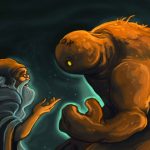
Today, we’re heading to California, to an abandoned dairy farm with a strange place in local folklore. Meet a creature that is half-human, half-goat, a tale involving a government conspiracy and whispers that have persisted in a small town for decades: The Billiwhack Monster.
So, let’s get into it. The Billiwhack Monster has a story that goes well beyond a strange creature on an abandoned farm. It involves Cold War paranoia, daring teenagers, and a legend that grew around a deserted dairy.
The Billiwhack Monster is a legendary creature said to have been sighted, particularly during the 1950s and 1960s, in Aliso Canyon, near the town of Santa Paula in Ventura County. Some describe it as half-human, half-goat, while others see it as a horned variety of Bigfoot. But the really interesting part isn’t just the monster itself. It’s the strange stories that grew around the old farm. So, where did the story come from?
Where the Legend Began: The Billiwhack Dairy
It all starts in the 1920s with a 400-acre plot of land near Santa Paula, purchased by a Swiss-born entrepreneur named August Rübel (sometimes spelled “Rubel”). Rübel’s ambition was to establish one of the nation’s premier breeding farms for Holstein cattle. He gave the property a rather curious name: “Billiwhack Stock Farm.” The term “Billiwhack” was military slang used during World War I, referring to “the place where one wears one’s hat,” a derivation of the word “bailiwick.”
In 1925, Rübel purchased a bull named “Prince Aaggie” for a record-breaking $110,000 and modernized the farm. However, a tragic event would alter the fate of both the farm and the legend. Prince Aaggie died in 1926, a loss that deeply devastated Rübel. Before long, the farm neared collapse and was sold in 1928. As for Rübel, he lost his life in 1943 while serving as an ambulance driver in North Africa during World War II.
With the farm falling apart and sitting mostly abandoned, it didn’t take much for local teenagers to turn it into a place full of monster stories. By the 1950s, the farm had fallen into ruin. With its concrete silos and dark basements, it became the perfect “haunted house” for local youth.
Description of the Creature: Horned, Hairy, and Ferocious
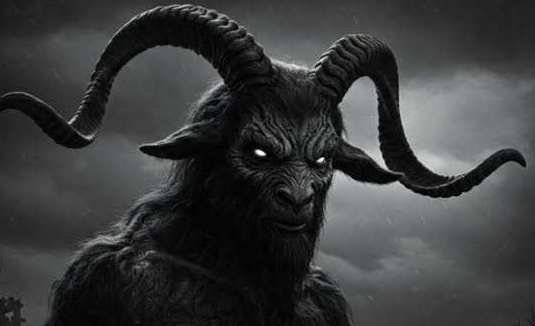
Not everyone described the creature the same way. Some said its fur was gray-white, while others claimed it was pitch black. Some thought its face resembled an ape, while others saw the features of an enraged ram. But almost every version of the story agreed on one thing: this was a massive, terrifying creature.
Most accounts describe the Billiwhack Monster as:
- Height: A colossal humanoid standing between 2 and 3 meters (7–10 feet) tall.
- Appearance: A bulky, ape-like body covered in long, disheveled gray-white fur.
- Head: The horns of a ram or a goat.
- Weapon: Said to carry a large wooden club or stick.
- Behavior: Aggressive and territorial. It was said to throw rocks, sticks, or even chunks of ice at passing cars, and to leap onto their hoods, denting the fenders.
The 1964 Craze: Youth and the “Monster Hunt”
Things really took off in 1964. That year, the Los Angeles Times began reporting on a strange creature roaming among the concrete structures of the former Billiwhack Dairy in Aliso Canyon. According to these accounts, local high school students had spotted the creature several times and became practically obsessed with exploring its territory.
One teenager claimed to have encountered a “hairy man” growling from a hole, while other reports described a tall, muscular, hairy figure with claws and ram-like horns. Before long, the story had become a local obsession. Teenagers headed into Aliso Canyon at night on “monster hunts.” There are even stories of one “monster hunter” wandering about with a sword, and another instance where 43 youths descended upon the dairy farm all at once. There are also reports of a boy being scratched by the creature.
That pretty much sums up what made the legend so popular. Teenagers wanted a thrill, and the abandoned dairy was the perfect place to find one. Of course, there was always the chance that whatever they were looking for might actually find them first.
So, Where Did This Conspiracy Theory Come From?
But there’s one thing that makes this story especially strange: the bizarre explanation for where the monster supposedly came from. According to one version of the legend, August Rübel was no ordinary farmer. The story claims he was secretly working for the OSS (Office of Strategic Services), the U.S. government’s wartime intelligence agency and the precursor to the CIA.
According to the tale, Rübel was conducting experiments in secret laboratories and tunnels beneath the farm, hoping to create “super-soldiers” for World War II. Naturally, one of these experiments went disastrously wrong, resulting in a half-human, half-goat monster. The creature was supposedly left to roam the abandoned farm and has haunted the area ever since.
However, the facts do not support this theory. Records of Rübel’s life describe him as a dairyman and farmer who served as an ambulance driver during the world wars. He died in North Africa in 1943 while attempting to rescue others. In fact, his own daughters stated in 2013 that their father did not even speak German and was, in reality, an ordinary businessman. The story also fits the mood of the postwar years, when fears about secret government experiments were widespread.
So, What Actually Happened? Possible Explanations
What did people actually see? There are a few possible explanations for the strange encounters reported around the old dairy.
1. Adolescent Pranks and Imagination: One likely explanation is that the legend grew out of teenage pranks and imagination. Stories made up to frighten friends in dark, eerie settings may have spread over time, eventually turning into a full-fledged legend. The fact that most eyewitnesses were adolescents makes this explanation worth considering.
2. Misidentification of Wild Animals: Animals native to the area, such as deer, wild goats, or large birds, could easily have been mistaken for something far stranger in the dark, especially during moments of panic.
3. Cautionary Folklore: Another possibility is that the story was deliberately invented to keep young people away from abandoned and dangerous farm structures filled with crumbling concrete, open wells, and other hazards.
4. Collective Paranoia: During the Cold War, many people feared that the government was hiding secret projects and conducting shady experiments. Those fears may help explain why the story caught on so easily and continued to spread. The Billiwhack Monster became a horned, hairy symbol of fears about what the government might be hiding.
Legacy: A Forgotten Yet Enduring Legend
Today, the Billiwhack Dairy buildings are gone, and the land has been redeveloped. Still, the legend lives on in Ventura County folklore. The Billiwhack Monster may not be as famous as Bigfoot or the Jersey Devil, but it remains one of California’s stranger local legends. Paranormal investigators occasionally include it on lists of “forgotten cryptids,” while local historians continue to collect accounts from older residents who remember the rumors that circulated in the 1950s.
The Billiwhack Monster shows how a few local stories can grow into a legend that lasts for decades. What began around an abandoned dairy farm eventually became a tale of horned creatures, late-night monster hunts, and secret government experiments. Even now, it’s a strange little piece of California folklore that hasn’t entirely faded away.
Sources
American Field Service Archive – August Alexander Rübel
https://the-afs-archive.org/people-in-afs/article/rubel-august-alexander-1-1924
Documents August Rübel’s wartime service and provides historical background on the man linked to the Billiwhack Monster legend.
California Folklife – The Billiwhack Monster of Ventura County
https://califolk.blogspot.com/2007/10/the-billiwhack-monster-of-ventura-county.html
Examines the monster legend, its alleged connection to secret government experiments, and the Cold War fears that helped shape the story.