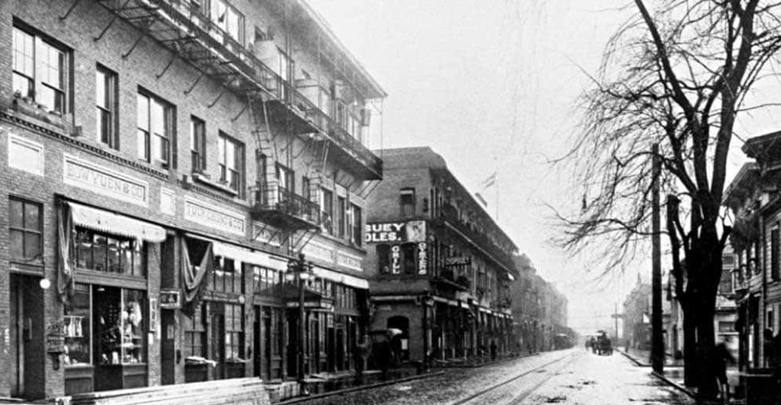
The Shanghai Tunnels history goes back to Portland’s days as a busy West Coast port, when underground passages beneath Old Town Chinatown became part of the city’s local folklore. Also known as the Portland Underground, these passages are said to connect the basements of old hotels, saloons, and shops, with routes supposedly leading all the way to the Willamette River.
Here’s how the story goes. In the late 1800s and early 1900s, Portland was a busy port, and ship captains were always short of crew. Men known as crimps solved that problem in the worst possible way. They drugged a man in a bar, dropped him through a trapdoor into the cellar, moved him through the tunnels to the waterfront, and sold him to a captain. He woke up miles out at sea, headed for somewhere like Shanghai, with no say in the matter. That’s where the word “shanghaied” comes from.
Here’s what most ghost pages skip: the kidnapping part really happened. Portland had a reputation as one of the worst ports on the West Coast for it. What’s disputed is the tunnels.
The Ghost Stories
Ask almost anyone in Portland about haunted places and the tunnels come up fast, usually next to one name: Nina.
Nina of the Merchant Hotel
The Merchant Hotel was built in 1880 in Old Town. Its old lobby is now Old Town Pizza & Brewing, which opened there in 1974, and the basement underneath is where the tunnel tours begin. Nina is the restaurant’s resident ghost, and her story comes in a few versions. In the most common one, she worked at the hotel (a madam in some tellings, a prostitute in others) and was found dead at the bottom of the elevator shaft, possibly pushed. Today that spot is said to be a booth at the back of the restaurant, and visitors have carved names into the wall around it.
The reports are small and human: a whiff of perfume, a tug on someone’s clothing, a figure glimpsed in the basement. One local story says a delivery driver ran out of the building, announced he’d seen the ghost, and asked to be taken off that route.
Other Old Town haunts
Nina has company. The White Eagle Saloon claims a ghost named Rose, and Kells Irish pub, which sits above what’s billed as a former tunnel entrance, has its own reputation for hauntings. It’s hard to find a bar in that neighborhood that doesn’t.
TV, podcasts and folklore
Ghost Adventures’ Zak Bagans hosted a tour of the tunnels in 2012, and the Travel Channel gave them an episode of Portals to Hell. Podcast descriptions promise disembodied voices and shadowy figures. A USC folklore collection from 2012 records a version that adds a train derailment in the tunnel, which I couldn’t match to anything in the history I found. That’s how these stories travel: every retelling picks up a new detail.
What Historians Say
Historians are not kind to the legend.
The Oregon Encyclopedia traces the modern myth to the 1970s, when a man named Michael Jones, who said he’d been exploring Old Town basements since 1969, started leading tours of the “shanghai tunnels.” Tours have run through his Cascade Geographic Society since 1979. Historians confirm that crimping and shanghaiing happened in Old Town, but they haven’t found evidence of a tunnel network tied to it. The encyclopedia’s blunt summary: visitors on the tour walk into a basement, not through a kidnapping tunnel.
A Portland Mercury writer made the same point in 2012 after sitting through Bagans’s tour. He mentioned that he works for a competing walking-tour company, so factor that in. His argument was that the “tunnels” are the basement of the old Merchant Hotel, and that the evening ran on drama more than evidence. The ghosts, he reported, simply didn’t show up that night.
But the story isn’t all myth either. Finn J.D. John of Offbeat Oregon argues it’s “mostly myth, but not entirely,” and his reasoning is worth following:
- There really are old underground passages, used to move goods and keep them out of the mud and rain.
- When Prohibition arrived in Oregon in 1914, a secret route between buildings suddenly became very valuable.
- Most shanghaiing happened out of bars, and plenty of the passages connect to bars.
- Shanghaiing faded between about 1900 and 1930 as steamships replaced sailing ships, but windjammers kept sailing into the late 1920s, and they still needed crews.
- Building the waterfront seawall meant demolishing dozens of buildings, which collapsed any tunnels beneath them. That’s why nobody can walk from a basement to the river today.
There’s one more detail I like. When crews dug up a downtown street in 1980, they found tunnels, and the Oregon Historical Society’s archive suggests those were likely built for illegal gambling dens.
So the fair summary is: real basements, real connecting passages, real kidnappings, and no proof that they were ever the same thing.
So… Are They Haunted?
The straight answer is that nobody has shown it. A ghost-hunting TV episode isn’t evidence; it’s entertainment. And a lot of the ghost stories hang on the shanghai legend. If sailors weren’t hauled through these tunnels, they can’t be haunting them.
What I can say is this:
- The experiences are sincere. People who work and eat in these buildings describe things that felt real to them. I don’t think they’re lying.
- Old basements are great at fooling us. Low light, cold air, drafts, creaking floors, and a guide who just spent twenty minutes telling you someone died right here. Your brain does the rest.
- The stories attach to the legend, not to documented events. Nina is the closest thing to an exception, and even her story exists in several conflicting versions.
Where I land: unproven, and probably more about storytelling than spirits. But that’s not the end of it, because I think the legend is haunting something else.
The Ghosts Everyone Forgets
If sailors dragged through tunnels is the shakiest part of the legend, who actually used the underground spaces of Old Town?
A Seattle Times piece quotes a local historian saying that Chinese residents lived in some of those spaces. Historian Barney Blalock has argued that the tunnels were built by Chinese workers back when Chinatown was a center of tong activity. Then there were the workers hauling goods through damp, flood-prone cellars (flooding of the Willamette is one of the reasons local historians give for doubting the legend), the bartenders and bootleggers of Prohibition, and the gamblers behind those 1980 finds.
Those are the real people. They left real traces, and over decades those traces were folded into a kidnapping legend while their names slipped away.
And then there’s the name. Travel Portland’s own page carries an editor’s note acknowledging that using “shanghai” for kidnapping is rooted in racism, and saying they use it only because it’s what people search for. The Clio history database makes a similar point: the nickname stuck partly because of anti-Asian stereotypes about Chinatown, with its rumored opium dens and secret passages. A neighborhood where Chinese families lived and worked became known as the place where men disappeared.
If I’m looking for a haunting, that’s the one that stays with me. Not a woman in an elevator shaft, but a community’s actual history buried under a spooky name. That’s my opinion, not a documented fact, but it makes me ask which stories we find thrilling, and whose stories get lost when we do.
If You Want to Visit
Old Town Pizza & Brewing runs the underground tour, and it bills itself as the only tour that actually takes you into the tunnels. According to the listings, the tour also visits the second-floor ballroom of the Merchant Hotel and ends with a beer tasting. Children under 13 aren’t allowed, and some tours are 21+ only, so check the booking page first.
A few tips from someone who has read far too much about it:
- Go curious, not convinced. It’s a good show and a good story.
- Ask your guide which parts are documented and which are legend. A good guide will happily tell you.
- Remember the neighborhood. Old Town Chinatown has a real history beyond the ghosts, and the Lan Su Chinese Garden is in the same area.
Quick Answers
Are the Shanghai Tunnels real? There are real basements and some connecting passages. Historians have found no evidence of a kidnapping tunnel network.
Are the Shanghai Tunnels haunted? People report ghosts, especially Nina, but nothing has been proven.
Who is Nina? The best-known ghost at Old Town Pizza, said to be a woman from the Merchant Hotel found dead at the bottom of an elevator shaft. The details change depending on who tells it.
Why are they called the Shanghai Tunnels? After shanghaiing, the practice of kidnapping men to crew ships, often bound for Asian ports like Shanghai. Many people today consider the term offensive.
Can you visit them? Yes, through the tour at Old Town Pizza & Brewing.
Final Thoughts
So, are the Shanghai Tunnels haunted? I honestly can’t tell you yes. What I can tell you is that the real story, a port town, a trade in stolen sailors, a Chinatown with a reputation it didn’t earn, and a basement that got famous, is stranger and sadder than the ghost version. And if you ever go down those stairs, I hope you’ll listen for more than footsteps.
Sources: